 odyvero
In Cascais, a small beach near the station, the red towers of Casa das Histórias Paula Rego and a rocky coastline make for a varied day out. Two nights open up more possibilities: visit museums without watching the time for your return, head to Guincho or set off from the marina. Here’s how to choose your stay, beaches and activities, with an itinerary that leaves room for each place.
A day or two nights
Cascais brings together several reasons to travel in an area whose different parts are worth understanding. The bay and town center are well suited to arriving without a car. The museum district makes it easy to extend your walk to the southwest. Farther away, Guincho and Quinta do Pisão require a specific trip. This geography explains why a day can be enough for a first look, while a short stay lets you experience very different landscapes.
For a day trip from Lisbon, we recommend setting aside three segments: the town center and bay, one museum, then Santa Marta or Boca do Inferno depending on the weather. That gives you a proper cultural visit, a meal break and a coastal walk. Adding a boat trip to the same day means cutting back elsewhere. Boarding times then become the first reference points for your itinerary.
Two nights are especially suitable for art and seaside enthusiasts. The first day can focus on the museums and town center; the next can include a marine activity, Guincho or a walk inland. You also get an evening in town. If your stay is mainly devoted to Lisbon, this stop means changing your base: it is most worthwhile if you genuinely want to spend time on the coast.
The train from Lisbon
The coastal train line from Cais do Sodré is the simplest option to consider for an independent day trip. Turismo de Lisboa recommends this route for the beaches along the line and Cascais. Once you arrive, the town center is close enough to start exploring on foot, without first transferring to the main sights. Check CP for trains and any disruptions on your travel date before setting out.
Calculate travel time from your accommodation, including the connection to Cais do Sodré, waiting time and the return journey. For an activity booked at the marina, allow extra time between the train’s arrival and the requested check-in time. A boat meeting point is not on the railway platform. The exact location may also vary between providers within the marina.
A car offers more flexibility if your accommodation is out of the way or you plan to spend the day inland. For the bay and museums, weigh that benefit against parking and the walking you will do afterward. Plan a separate route from the airport: arriving in Lisbon does not mean you are already at the station where the Cascais line departs. With luggage, the simplicity of the final leg matters as much as the stated journey time.
The bay and Praia da Rainha
Start by heading to the water and taking in the layout of the town center: the shopping streets, beach access points, boats and façades lining the bay. This first loop helps you locate the station in relation to your return trip and choose somewhere for lunch. It also gives you an initial sense of the close relationship between the town and the coastline.
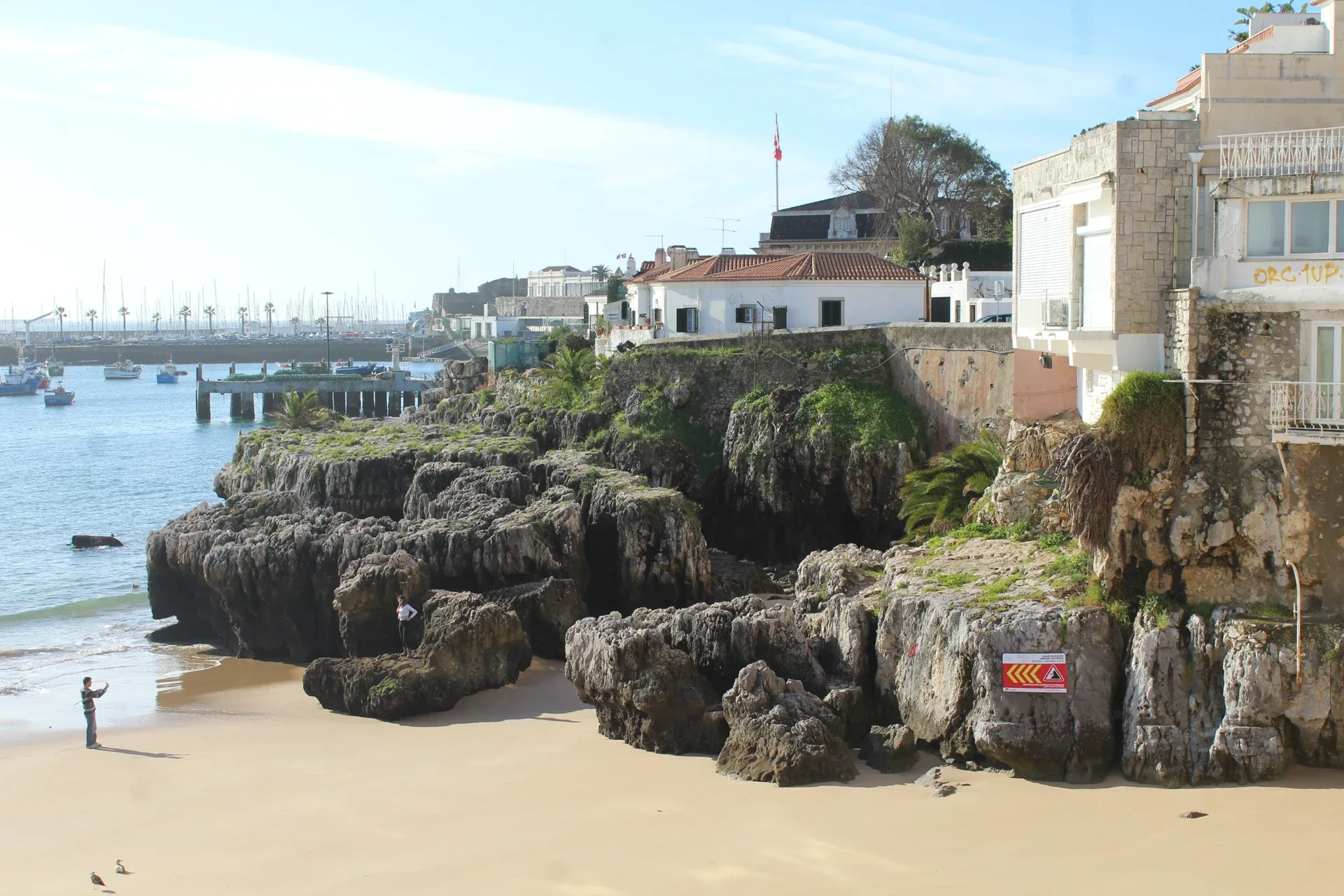
Praia da Rainha is a good first stop. The tourist office describes it as a small sheltered beach between built-up slopes, near the station and accessible from a street in the town center. Its appeal lies in this urban setting: just a few steps separate the houses from the sand. For taking in the scenery or a short break, it fits easily into a cultural visit.
Let its size guide your choice if you plan to spend several hours at the beach. A small central cove can fill up quickly; look for a spot that suits your group rather than settling right beside an access point. With young children, identify the exit, accessible toilets and a place to shelter from the sun as soon as you arrive. The sheltered setting does not remove the need to check the sea conditions and that day’s swimming guidance.
Casa das Histórias Paula Rego
The two red towers of Casa das Histórias provide an instantly recognizable landmark in the museum district. The building, designed by Eduardo Souto de Moura and opened in 2009, is worth observing from the outside. Its silhouette sets the scene for a visit centered on an artist’s work in which stories, figures and relationships between characters play an important role.
The tourist office lists paintings, drawings and prints by Paula Rego, as well as works by Victor Willing. The managing foundation organizes temporary exhibitions about the artist and different perspectives on her work. Check the current program before your visit: it determines which works are actually on display. Allowing an hour to an hour and a half is a reasonable estimate for a first visit, with more time if an exhibition particularly interests you.
Fundação D. Luís I lists its opening hours as Tuesday to Sunday, 10 am to 6 pm, with last admission at 5:40 pm and closures on certain dates. Mondays therefore deserve particular attention when planning a long weekend. Check the latest information rather than rearranging your whole day at the last minute. These museum hours do not automatically apply to other establishments in Cascais.
With children, choose a few works to look at together instead of moving through every gallery at the same pace. The cultural and educational department’s activities can also help shape your visit if they coincide with your date. If you have a specific accessibility need, ask directly about the visitor route: a contemporary building alone does not tell you everything about the access arrangements.
Collections by the sea
The Museu Condes de Castro Guimarães offers a different relationship with art: that of a residence by the water, in the Marechal Carmona Park area. The palace was built in 1897. Its setting, tower and historicist architecture already make the exterior worth exploring, even before you enter the collections.
The route presented by the tourism office brings together works of art, Indo-Portuguese furniture and a library, among other things. An illuminated manuscript dated 1505 is one of the featured items. This museum suits visitors who enjoy reading a place through its objects and interiors. Combining the residence with a walk in the park gives you an experience distinct from the Casa das Histórias, with a greater focus on heritage and the landscape.
The Museu do Mar — Rei D. Carlos, meanwhile, sheds light on the ocean’s place in local history. Its collections cover natural history, ethnology and nautical archaeology; the tourism office mentions old maps, fishermen’s clothing, models and objects recovered from shipwrecks. It is a fitting choice before a trip out to sea, or if you want to give more meaning to the boats you see in the bay.
If you have just one day, choose the museum whose contents appeal to you most. Visiting all three is not a requirement. If you are staying two nights, you could set aside one morning for Paula Rego, then choose another time slot for the maritime heritage or the Castro Guimarães residence. This split leaves time to explore the collections and avoids spending the best hours for a walk going from one admission to the next.
Santa Marta and Boca do Inferno
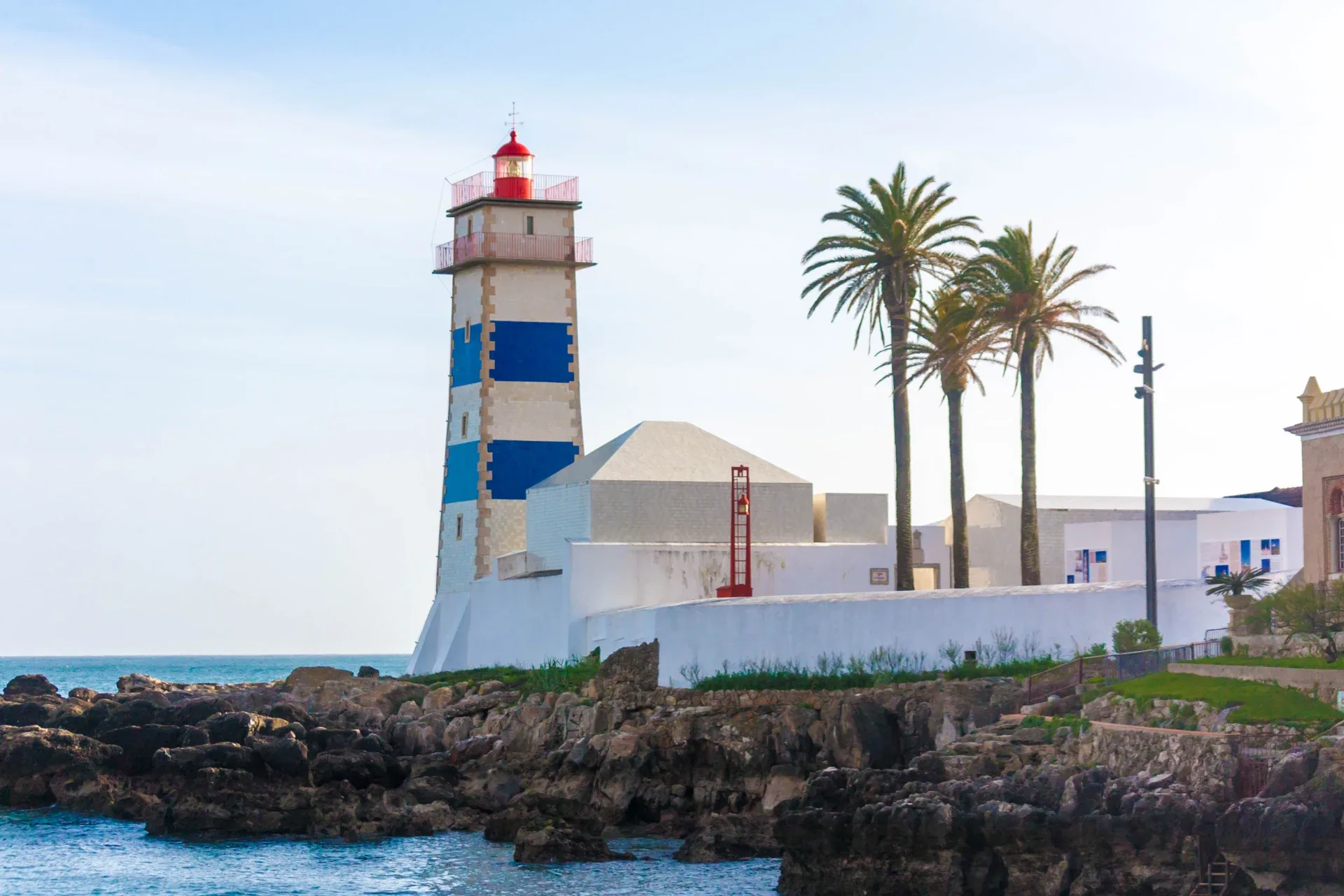
The Santa Marta Lighthouse naturally extends your exploration of the museum district along the coast. Its blue-and-white striped tower stands out beside the rocks. Built in 1868, it is now home to a museum devoted to the history of Portuguese lighthouses, according to Visit Cascais. The visit connects the bay’s landscape with navigation and the systems that guide vessels along this coast.
A look at the exterior can be a worthwhile stop in its own right. If you want to enter the museum or climb the tower, check the day’s conditions on the website; the presence of a lighthouse museum does not guarantee permanent access to all its spaces. You can combine a stop at Santa Marta with a longer visit, or make it a brief walking break, depending on your interests and what is open.
Boca do Inferno lies farther along the coast. The site’s appeal comes from the rock carved by the sea and the arch through which the waves surge. The coastal path and viewpoints let you see this formation from the developed areas. Allow extra time for the return to the centre: the walk takes longer when you stop to watch the shoreline.
In heavy seas, waves can send spray into the air and make some nearby areas exposed. Respect barriers and closures, stay on authorised paths, and don’t try to get a shot that would require climbing down onto the rocks. A rough-sea day can easily be spent in the museums instead. For coastal photographs, pleasant light and safe access matter more than the size of the waves.


Beaches to suit your plans
Cascais’s small beaches are ideal for a break between visits. The station, shops and cultural attractions can all fit into the same itinerary. They are a good choice if you want to spend part of the day on the sand and then return to the centre, without planning an entire trip around swimming.
Guincho makes for a bigger outing. Turismo de Lisboa places this area about six kilometres from the centre and highlights its winds, which are particularly popular with windsurfers and kitesurfers. Visit Cascais describes the dunes and the Serra de Sintra hills that shape the landscape of the natural park. We recommend it first and foremost for its vast open scenery and activities suited to the actual conditions.
Plan your transport to and from Guincho before you set off. The distance from the centre, exposure to the wind and any stops along the way make it worth setting aside half a day rather than making an impromptu detour after visiting all the museums. If you are taking your first watersports lesson, choose a school and package that suit your level, then let the instructor decide whether the session can go ahead. Conditions that are appealing to an experienced participant can be challenging for a beginner.
Carcavelos offers another option along the coast. Turismo de Lisboa mentions surf schools there and says that beginners can surf with instruction. Treat this beach as a separate stop on your journey, with time set aside for it. For a day focused on Cascais, it is generally more pleasant to stick to Rainha or the urban beaches; for a day of lessons and beach time, you can build your plans around Carcavelos.
Dolphin watching from the marina
For a local activity that takes up part of the day, we have selected the dolphin-watching trip listed on Viator under reference 429725P1. It departs from Cascais Marina and returns to the same point. The advertised trip lasts two hours and takes up to twelve participants. The listed languages are English, Portuguese and Spanish.
The crew looks for the animals offshore and adjusts the route to the sea conditions and sightings. The appeal lies in discovering the marine environment with a crew while keeping a respectful distance. Dolphins are wild animals, so their presence cannot be guaranteed. Choose this trip if you are interested in the experience as a whole, even if sightings are brief or there are none.
Life jackets and a windproof or waterproof layer are among the inclusions listed. The product is not recommended for children under two, pregnant women, or travellers with certain back or cardiovascular problems. If you have a specific medical condition, speak to the provider before booking. The exact meeting point and check-in time on your confirmation take precedence for boarding.
If you are taking this excursion from Lisbon, book it before choosing your museum and lunch. If you are staying two nights, try to keep another half-day free so you can discuss rescheduling if the weather makes it necessary, subject to the offer’s conditions.

Viator
Dolphin watching from Cascais
For two hours exploring the marine environment from Cascais in a small group with a guide speaking English, Portuguese or Spanish; dolphins are wild animals and sightings are not guaranteed.
- 2 h
- 5/5 (37 reviews)
Two-hour group trip departing from the marina, with up to twelve participants; available in English, Portuguese or Spanish. Safety equipment and a windbreaker included; sightings are not guaranteed.
Cancellation policy
For a full refund, cancel at least 24 hours before the scheduled departure date.
From €65.00
View activityThe sunset sail
The private trip listed under reference 5681431P2 offers a different experience: admiring the coast from the water and spending two hours sailing at the end of the day. The advertised meeting point is Pier H at Cascais Marina. The provider asks guests to get in touch after booking to confirm arrangements.
We recommend it above all for couples or friends staying overnight. You can finish the sail without having to rush on to a timed visit. The listed languages are also English, Portuguese and Spanish; the listing we checked includes drinks. Check the capacity and scope of the package you select when booking for your group.
The departure time depends on the provider’s arrangements and the time of year. In autumn or winter, an activity described as a “sunset” sail may begin well before the usual dinner hour. Bring a warm layer and keep your belongings in a bag that is easy to keep close by. Cloud cover affects the colours in the sky; the main attraction remains the sail and the views of the shoreline.

Viator
Private sunset sailing trip in Cascais
For an evening with your partner or friends aboard a private boat, returning to Cascais; confirm the departure from Pier H after booking, especially if you are visiting in autumn.
- 2 h
- 5/5 (30 reviews)
Two-hour private trip from pontoon H at Cascais Marina, with drinks; available in English, Portuguese or Spanish. Confirm the time with the provider.
Cancellation policy
For a full refund, cancel at least 24 hours before the scheduled departure date.
From €450.00
View activityA one-day itinerary
For a first visit without a boat trip, here is a suggested pace to adapt to the actual opening hours. Arrive by train in the morning, then head to the bay and Praia da Rainha. Spend this first part of the day in the centre before going to the Casa das Histórias or the museum of your choice. You can fit in a coffee break along the way without needing another booking.
After your visit, plan an early enough lunch to leave the afternoon free for walking. The Marechal Carmona Park area and the surroundings of Santa Marta make for a natural continuation. Continue to Boca do Inferno if the weather, light and energy of your group allow. Then head back towards the centre and the station, with one last break rather than squeezing in another visit just before closing.
If you are going dolphin watching, keep it simple: visit the bay and a museum on one side of the boat trip, then have lunch and return on the other. With children, a short beach visit and one museum can fill the day. For a collections enthusiast, two nearby museums and Santa Marta are enough. The right itinerary depends on what you want to spend time looking at; keep walking times and breaks visible in your schedule.
Two nights between the town and nature
Over two nights, the first day can follow a loop through the town centre, Paula Rego and Santa Marta. Keep the evening free for dinner and a stroll through the streets near your accommodation. The next morning, choose between wildlife watching at sea and an outing to Guincho. Keeping this alternative open until you have checked the forecast helps you make better use of your stay.
Quinta do Pisão offers a different option for those who prefer the countryside. The tourist office places the estate in Alcabideche, within Sintra-Cascais Natural Park, and describes agricultural landscapes, meadows and wooded areas criss-crossed by trails. Walking and cycling are among the activities available. Before arranging transport, check access details and which guided activities are available on your date.
Set aside a proper half-day for this visit, and bring water and suitable shoes; arrange your return in advance. The time required depends on the route you choose, so use the estate’s information to select one that suits your group. The third day can be kept short: a second museum, an urban beach or a leisurely breakfast before departure. This leaves room to enjoy the two nights without turning your final morning into another regional tour.
The neighbourhood and meals
For a first visit without a car, look for accommodation with a walking route to the station, town centre and marina that works for you. Check the actual route with your luggage, whether there are stairs and how you will access your room. An address listed as being in Cascais may be far from the bay; the municipality and the tourist centre are not the same thing when it comes to getting around day to day.
A more out-of-the-way place can suit a stay focused on Guincho, golf or activities already arranged with transport. Compare the total cost, including accommodation, travel to meals, possible parking and the flexibility to return in the evening. For just two nights, being able to walk to dinner is often more useful than a long list of amenities you will rarely use.
Fish and seafood feature prominently in Visit Cascais’s presentation of local cuisine. To choose a restaurant, check a current menu and the service arrangements. If fish is sold by weight, ask about the proposed weight and estimated price before ordering. If you have an allergy, ask the restaurant directly about ingredients and preparation. A terrace overlooking the water and a simple meal away from the seafront suit different moments of your stay; you can alternate between them according to your budget.
Seasons and budget
In spring and autumn, we recommend planning your stay around walking, collections and an outdoor activity chosen according to the forecast. In late October, a day in Cascais can easily focus on Paula Rego, maritime heritage and a coastal walk during the best weather window. Bring something to protect you from the wind, and check when it gets dark before setting out farther afield.
In summer, set aside more time for the beach if that is your goal, and bring sun protection and water, with breaks in the shade. Include how busy the urban beaches are and how exposed Guincho is when choosing where to go. In winter, museums provide fixed points in your itinerary; boat trips and coastal walks remain weather-dependent. No month alone guarantees calm seas or pleasant swimming conditions.
For your budget, separate transport, meals, visits, booked activities and any accommodation. An independent day with a walk and a museum gives you more flexibility than one that includes a private sailing trip. Compare offers on an equivalent basis: number of travellers, package, inclusions and terms. Updated prices and reviews for activities are shown on their listings; add travel to the meeting point and personal expenses to your calculation.
FAQ
How long does it take to visit Cascais?
One day is enough to explore the centre, the bay, a museum and part of the coastline on foot. Two nights work well if you want to add Guincho, a sea-based activity or several collections while still leaving time for meals. Scale back the itinerary if boarding requires you to be there at a specific time or the weather shortens your walks.
Can you visit Cascais without a car?
Yes, for the town centre and an initial cultural visit. The coastal train leaves from Cais do Sodré in Lisbon, and Cascais station is near the first urban beaches. Getting to Guincho or Quinta do Pisão then requires separate transport. Check rail service and the final leg to your accommodation or activity.
Which beach in Cascais should you choose with children?
Praia da Rainha is a convenient stop at a small, sheltered beach in the centre, close to local amenities. It is small, and swimming conditions should be checked on site. For a proper day on the sand, choose a beach with the space and facilities that suit your family. Guincho is exposed to the wind and should be planned as a different kind of outing; seeing people doing water sports there is not an indication that swimming is safe.
What can you do in Cascais when it rains?
Casa das Histórias Paula Rego is a good first choice for art; Museu do Mar offers a maritime perspective on the town, while the Castro Guimarães collections will appeal to visitors interested in historic houses and objects. Check each venue’s opening days. Plan travel between venues during breaks in the rain rather than committing to a long coastal walk.
Do dolphin-watching trips guarantee a sighting?
No. On the trip featured in this guide, the crew looks for wild animals and adjusts its route to the conditions. The experience includes a guided boat trip; sightings depend on the natural environment. Read the terms covering weather and possible rescheduling, and choose a time slot that gives you enough time to reach the marina without rushing.
Can you combine Sintra and Cascais in one day?
Yes, provided you treat Cascais as a brief stop and carefully limit the number of visits in Sintra. If you want to visit a museum in Cascais, have lunch, walk to Boca do Inferno and enjoy the bay, a dedicated day is more comfortable. If you choose a regional tour, check how much time it actually allows in Cascais before comparing it with this guide’s independent itinerary.
Can you visit Cascais in autumn and winter?
Yes, by giving more time to museums and the town centre. The coast is still worth seeing, with your plans adjusted to the wind, rain and available daylight. Boat trips depend on sea conditions and scheduled departures. Have an indoor alternative and check for special closures around the holidays rather than relying only on the usual opening hours.
Where should you stay for two nights without a car?
Choose accommodation with an easy walking route to the station and the places where you plan to spend time. If you are going on a boat trip, also check access to the marina. Verify the exact location, stairs and luggage drop-off arrangements. Staying centrally makes evenings and departure easier; if you consider a more distant address, compare the price of the nights plus daily transport.
Sources and checks
Plan your visits and check current conditions.
- Cascais: stay, culture and gastronomy
Visit Cascais · Accessed November 1, 2026
What this source supports
Museums, parks and the place of fish and seafood in the local offering.
- The beaches along the Cascais line
Turismo de Lisboa · Accessed November 1, 2026
What this source supports
Train access from Cais do Sodré; Carcavelos and surf schools; Guincho and Cresmina about 6 km away, exposed to the wind.
- Praia da Rainha
Visit Cascais · Accessed November 1, 2026
What this source supports
Small sheltered beach in the center, close to the station.
- Casa das Histórias Paula Rego
Visit Cascais · Accessed November 1, 2026
What this source supports
Opened in 2009, architecture by Eduardo Souto de Moura, red towers, paintings, drawings, prints and Victor Willing.
- Paula Rego visitor information
Fundação D. Luís I · Accessed November 1, 2026
What this source supports
Temporary exhibitions, open Tuesday to Sunday 10 am–6 pm, last admission 5:40 pm; check again for specific closure dates.
- Museu Condes de Castro Guimarães
Visit Cascais · Accessed November 1, 2026
What this source supports
1897 palace, art collections and Indo-Portuguese furniture, library, 1505 manuscript and Marechal Carmona Park.
- Museu do Mar — Rei D. Carlos
Visit Cascais · Accessed November 1, 2026
What this source supports
Natural history, ethnology, nautical archaeology, maps, clothing and models.
- Santa Marta Lighthouse
Visit Cascais · Accessed November 1, 2026
What this source supports
Lighthouse built in 1868, blue-and-white tower, lighthouse museum.
- Boca do Inferno
Visit Cascais · Accessed November 1, 2026
What this source supports
Rock arch shaped by the sea, coastal walkway and viewpoints.
- Guincho Beach
Visit Cascais · Accessed November 1, 2026
What this source supports
Dunes, Sintra hills and location within Sintra-Cascais Natural Park.
- Quinta do Pisão
Visit Cascais · Accessed November 1, 2026
What this source supports
Estate in Alcabideche, agricultural landscapes, woodland and meadows, walking and cycling.
- Dolphin watching from Cascais
Viator — Partner API · Accessed November 1, 2026
What this source supports
Two-hour group trip departing from the marina, up to twelve participants; English, Portuguese or Spanish. Safety equipment and windbreaker included; sightings are not guaranteed. Exact listing rechecked in the Basic API; affiliate link provided by our API. Details may vary in the central listing.
- Private sunset sailing trip in Cascais
Viator — Partner API · Accessed November 1, 2026
What this source supports
Two-hour private trip from pontoon H at Cascais Marina, with drinks; English, Portuguese or Spanish. Confirm the time with the provider. Exact listing rechecked in the Basic API; affiliate link provided by our API. Details may vary in the central listing.
- Photograph: rainha
Wikimedia Commons · Accessed November 1, 2026
What this source supports
Dguendel — CC BY 4.0; resized and converted to WebP, without upscaling. Original dimensions and derived file checked; image inspected.
- Photograph: marta
Wikimedia Commons · Accessed November 1, 2026
What this source supports
Rúdisicyon — CC BY-SA 4.0; resized and converted to WebP, without upscaling. Original dimensions and derived file checked; image inspected.
Viator — activity pages
Information about the offers featured in this article.Affiliate links: Odyvero may earn a commission when you book through this article’s buttons.
- Viator : Dolphin watching from Cascais
Accessed November 1, 2026
- Viator : Private sunset sailing trip in Cascais
Accessed November 1, 2026


