 odyvero

To travel between Amalfi, Matera, and Puglia in two weeks, plan four nights in Salerno, two in Matera, four in the Itria Valley, and three in Bari. Start with boats and buses on the Amalfi Coast, then rent a car to cross to the Adriatic: you’ll have time left for villages, meals, and walks.
The stops and the thirteen nights
The terrain gives this trip two distinct rhythms. On the Amalfi Coast, villages cling to slopes, roads wind around cliffs, and every parking spot is followed by a walk. In the Itria Valley, by contrast, small roads connect towns and scattered accommodations. Using the same approach in both regions makes the first few days harder and the later ones more complicated.
So our itinerary starts in Salerno, a practical gateway for exploring the coast by sea. The car joins the trip on day five, when you head to Matera. After two nights in Basilicata, four nights in the Itria Valley let you visit Alberobello and the surrounding villages without packing up every day. Bari is your base for the final three nights, with Polignano along the way and a day free for the weather or an extra walk.
The nights are allocated as follows: days 1 to 4 in Salerno; days 5 and 6 in Matera; days 7 to 10 in the Itria Valley; days 11 to 13 in Bari; departure on day 14. This is a suggested pace, with transfer days deliberately left open. Your arrival and departure points may vary depending on your tickets.
First compare flights that let you arrive in the Naples area and depart from Bari, then check the cost of returning a rental car to a different branch. A cheaper ticket may lose its appeal if it requires a long drive back to the first airport. Conversely, returning to the same airport is still an option if you set aside an extra day for the journey.
Season and transportation
For this trip combining walks, villages, and the sea, we recommend May, June, and September. April and October also work for a stay focused more on sightseeing, with flexible plans for coastal days. These editorial recommendations don’t guarantee swimming temperatures or clear skies. Sea activities depend on actual conditions, even when a date is being offered for sale.
In July and August, the heat makes early starts and long breaks more worthwhile. Walking days in Matera, the steps in Positano, and the streets of Alberobello require a different distribution of effort. A well-located room, accommodation where you can return to rest, and a less packed schedule may matter more than adding another stop.
In late autumn and winter, keep the cities and villages as the framework for your stay. Travelmar advertises service year-round, but check the stops, the departures actually offered, and traffic information for your dates. Also plan a possible overland return. Shuttle, boat, and bus schedules don’t remain the same from one season to the next.
The order of the three coastal days can therefore change: calm seas for Positano, dry weather for the walk, and a less predictable day for Amalfi and city sightseeing. Staying in the same accommodation for four nights gives you this flexibility without having to cancel a string of bookings.
Salerno, your base for the first few days
Use the first day to get to Salerno and settle in. Choose accommodation by considering the train station, the pier for your boat, and the walk with your luggage at the same time. If a place is described as “near the port,” check it against the actual pier being used: the general name of the port isn’t enough to plan an early departure.
This base suits travelers who would rather spend their budget on outings than on a room with a view in Positano. Above all, it lets you reach the coast without driving as soon as you arrive. An evening stroll, dinner, and picking up what you need for the hike can fill this first stop. If you arrive late, move the first full-day outing to the following day.
Staying directly in Amalfi is another sensible option if evenings on the coast are especially important to you. In that case, compare the room’s full cost, access, and luggage transport. Four nights in one place are still preferable to a string of short stays in Amalfi, Positano, and Ravello: those transfers take up the hours you wanted to spend out and about.
Before booking, ask whether there are stairs to reach the room. On an itinerary that already involves plenty of steps, accommodation advertised as a few hundred meters away can require very different effort depending on the slope and your luggage.
Amalfi and the heights of Ravello
Day two can include both Amalfi and Ravello. Reaching Amalfi by boat lets you see how the houses, cultivated terraces, and terrain fit together. The national portal Italia.it describes this coast as a cultural landscape listed as a World Heritage Site: buildings and cultivation on the slopes contribute to its character as much as its coves.
In Amalfi, start by spending time in the center and at the cathedral. Explore the square, the streets rising from the sea, and the side passages on foot. Leave time for lunch rather than immediately adding a second boat trip. If you plan to visit a paid interior, check the monument’s visiting arrangements and distinguish them from access to the square.
Ravello is higher up. Plan the overland connection from Amalfi and the return before choosing a time to visit a garden. The gardens of Villa Cimbrone are among the places featured by Italia.it; the hotel and the visitor areas serve different purposes. Check opening hours and the ticket that matches your plans.
This day already involves several transfers. If you want to explore a museum in Amalfi or have a leisurely lunch, save Ravello for another time and stay nearby. The benefit of a stable base is also that you can skip a leg of the journey when you’re enjoying a place more than the planned itinerary.
Positano and the hiking day
Set aside a day for Positano, without adding a visit to Capri. Arriving by sea, the steep streets and the stairways are enough to make for a varied day. A walk starting from the shore can gradually climb through the neighborhoods; save enough energy to go back down and reach your boat. Check the last return you can use as soon as you arrive.
On day four, if you enjoy walking, take the Path of the Gods between Bomerano and Nocelle. Bomerano is part of Agerola; Nocelle lies above Positano. This distinction affects the logistics: finishing the trail in Nocelle does not mean you are already at the pier. The descent into town and the final connection still take time and require effort.
Travelmar describes a combination of a ferry to Amalfi followed by a shuttle to Bomerano, near Piazza Capasso. Check the service for your chosen day and plan your return from Nocelle separately. The route is linear: leaving a car at the starting point adds another pickup to arrange. That is a good reason to keep this day in the part of the trip without a rental car.
Bring suitable shoes, water and sun protection, and make sure the weather is favorable. Exposed sections require you to be comfortable with heights; a general difficulty rating is no substitute for your own assessment of the terrain. Don’t turn a wet day into a hike you have to do just because it is on the calendar. For a group that prefers less walking, a village visit, a short stroll and lunch make a complete day, with no obligation to take the trail.
The drive to Matera
On day five, pick up the car and drive to Matera. Treat this transfer as the day’s main activity. Departure time depends on the rental agency, the vehicle inspection and where you pick up the car; a driving-time estimate does not include these steps. Allow for breaks and settling in on arrival before considering a reserved visit.
Matera is in Basilicata. This stop connects the two coasts and deserves two nights, leaving a full day to explore the Sassi. Before choosing accommodation, ask where you can park legally and how to reach the room with your luggage. The final approach may involve walking up stairs or over cobblestones.
On arrival, a short walk from the viewpoints is enough. The terraces, facades and spaces carved into the rock become easier to make out when you take time to observe the changes in elevation. Italia.it links the Sassi with the rocky landscape of the Murgia; you can explore that connection further the next day.
Accommodation in the Sassi puts you right by the evening walking routes. A place in the upper town may make arrival and handling luggage easier. Choose according to your mobility and how many return trips you expect to make, then confirm parking rather than assuming it exists based on photos of the room.
Matera, the Sassi and the Murgia
A full day in Matera lets you combine a walk through the Sassi, an indoor visit and several breaks. The city is best explored vertically: a viewpoint reveals the whole, then the alleyways show you the entrances, courtyards and homes. To understand the area, a well-documented interior offers more than a succession of panoramas.
A guided tour is useful if you want to place these buildings in their historical context. The tour with Giulio selected here lasts two to three hours, is in a group, and meets at Piazza Vittorio Veneto. The guide is listed as speaking Italian in the supplier information. This option therefore suits readers who understand Italian; choose a tour in another language only if the listing actually offers one.
Admission to the cave dwelling mentioned on the tour is separate. Allow for this expense and the time it takes if you are interested in visiting the interior. The listing lets you check the current commercial terms; then keep some free time in your day for lunch and to resume walking at your own pace.
The Murgia Materana Park is a separate visit. A panorama from the city, an urban guided tour and a hike on the other side of the ravine involve different journeys. If you want to explore the park, choose an open route through the park authority and set aside dedicated time for it. With only this one full day, the Sassi are the simplest priority.

Viator
The Sassi of Matera with an Italian-speaking guide
To understand the Sassi during your full day in Matera, if you understand Italian; allow two to three hours and separate admission to the cave dwelling.
- 5/5 (266 reviews)
A two- to three-hour guided group walk departing from Piazza Vittorio Veneto; admission to the cave house is separate.
Cancellation policy
For a full refund, cancel at least 24 hours before the scheduled departure date.
From €15.00
View activity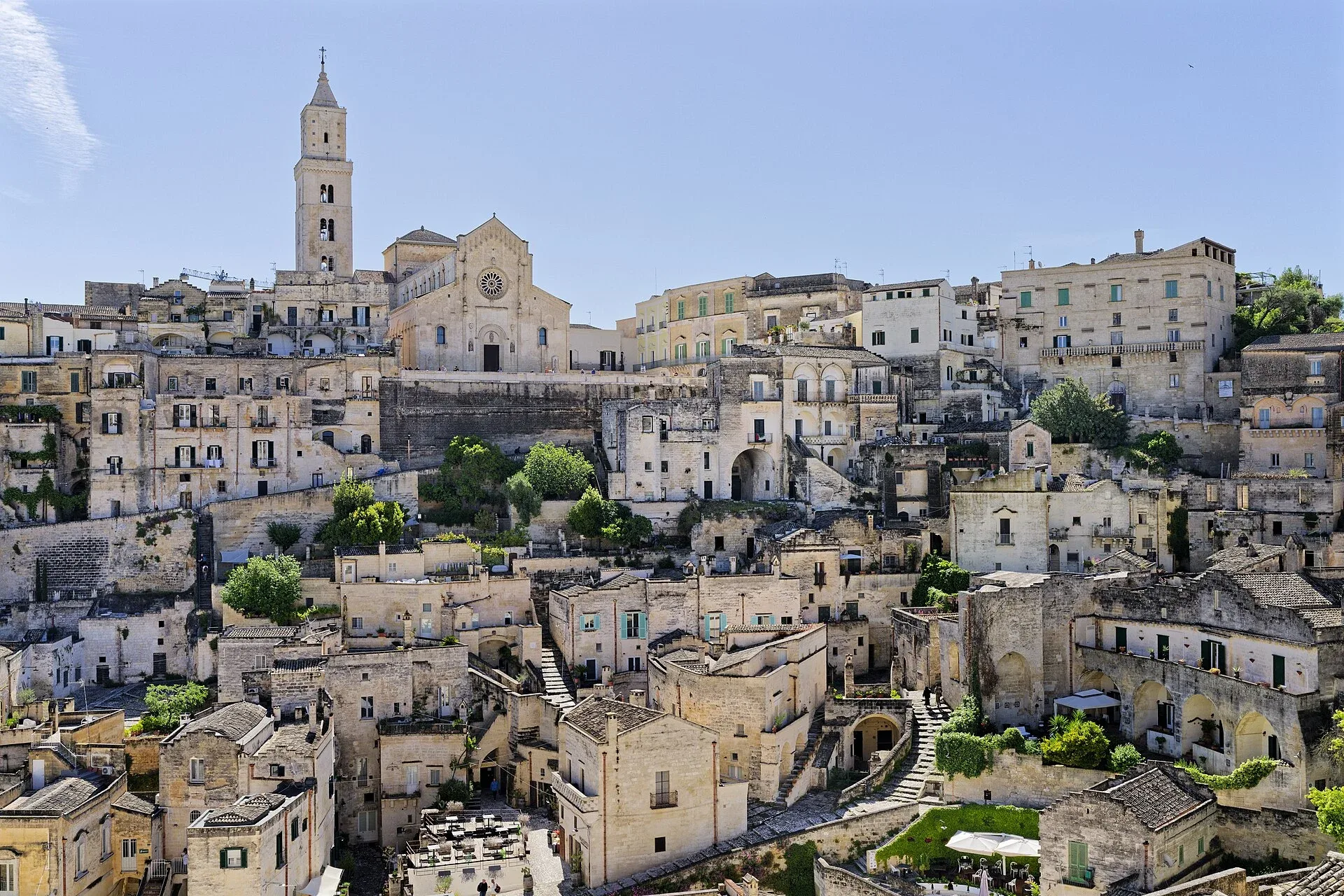

Four nights in the Itria Valley
Day seven takes you to a base in the Itria Valley, around Locorotondo, Cisternino or Alberobello, depending on your accommodation. A car is useful here for reaching the villages and a rural property. Compare daily driving times, parking and the option to dine on-site: a remote room may mean getting back behind the wheel every evening.
Your first day in Puglia can be a short one: settle in, stroll through one town and have dinner. The whitewashed walls, alleyways and views across the countryside are best enjoyed without another long drive immediately after Matera. Ask your accommodation for a specific parking address, especially if reception is in the historic center.
On day eight, prioritize Alberobello. The trulli combine dry-stone masonry with conical roofs; their concentration gives the town its architectural appeal. Rione Monti has a large concentration of these buildings and shops. Aia Piccola retains a stronger residential character: its doorways and thresholds belong to residents, even when they feature in a popular photo composition.
A museum or the Trullo Sovrano can round out the walk, depending on opening hours. Visiting an interior helps you understand the living space behind the rooflines. Set aside a proper half-day and time for a meal, rather than making a brief photo stop between several towns. You can then return to your base or take a short walk through another nearby village.
Ostuni and the countryside days
Day nine can be devoted to Ostuni, with a walk through its historic center and lunch. Focusing on one main town leaves time for side trips, stairs and breaks. Your accommodation remains your return point; you don’t have to reload all your luggage into the car for every new village.
Day ten is deliberately more open. Choose another town in the valley, a pre-booked visit to a producer, or a day around your accommodation. For an olive oil tasting, check the production location, what the visit includes and which languages are offered. For wine, plan who will drive before booking the tasting.
A stay at a masseria may make this free time worthwhile if the property actually offers a meal, outdoor spaces or an activity that interests you. The term refers to a type of property, not a list of amenities included with every room. Check the booked offer to confirm whether there is a pool, a restaurant and when they operate.
This light day also provides a buffer for a change in weather or an unexpected travel delay. It avoids having to sacrifice Alberobello because a departure ran late. If you like packed schedules, add a carefully chosen visit after assessing the distances; the Gargano and the far south of Salento require a different trip itinerary.
Polignano, the cliffs and San Vito
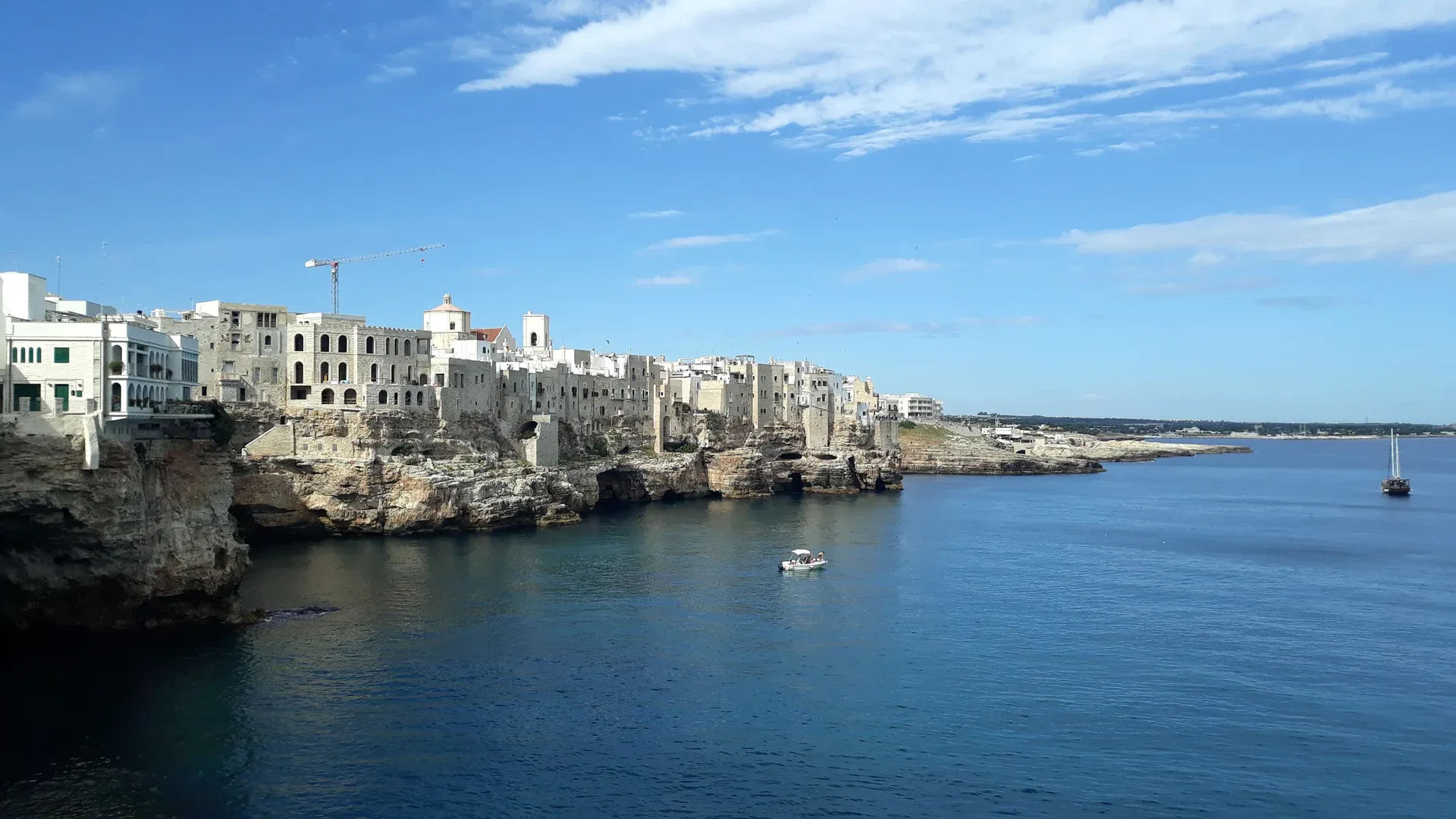
On day eleven, head to the coast and Polignano a Mare before finishing in Bari. The town center overlooks a limestone coast cut through with caves. From land, the viewpoints and the area around Lama Monachile are already enough to show the relationship between the houses and the cliff. The small beach sits in a narrow inlet and is very busy in summer, according to Italia.it.
To see this coastline from the water, a boat trip makes a useful addition to your walk. The one selected here departs from San Vito and is listed as lasting an hour and a half, with a maximum of ten passengers, in English or Italian. The meeting point is not in the middle of Polignano’s historic center: plan how you’ll get to the port before choosing a time slot.
The route features the caves and cliffs, with a swimming stop depending on conditions. A small aperitif is included in the listing consulted. Sea conditions determine how close the boat can get and whether swimming is possible; plan this as a coastal outing and leave time for a walk on land as part of your day.
One alternative is to leave the valley earlier, drop your luggage in Bari and return to the coast another day. This takes the luggage out of your plans, at the cost of an additional journey. In any case, avoid leaving visible belongings in the car during your visit, and follow the parking instructions from the rental agency and your accommodation.

Viator
Boat trip around Polignano departing from San Vito
To see the cliffs and caves from the sea during the trip to Bari; head to San Vito and keep another day available in case of rough seas. English or Italian.
- 5/5 (40 reviews)
A 90-minute group trip from San Vito, in English or Italian, with a maximum of ten travelers; aperitif included, route depends on sea conditions.
Cancellation policy
For a full refund, cancel at least 24 hours before the scheduled departure date.
From €35.00
View activityBari Vecchia and the final day
Spend the twelfth day on foot in Bari Vecchia. The Basilica of Saint Nicholas, Piazza Mercantile, Piazza Ferrarese and the old town’s narrow streets can provide the thread for a walk. The time saved on transport allows you to add an indoor visit or have lunch without watching the clock for a departure to another base.
The selected food tour combines this discovery with tastings. It lasts three hours; French is among the languages offered, and a bilingual format may be possible depending on the group. The meeting point is in town, with transfers from the hotel or port booked separately. Check the time slot in your language and mention any dietary requirements before paying.
This booking works better in the middle of a free day than between a flight and a train departure. Tours advertised around the castle or cathedral do not necessarily include admission to their interiors. Decide separately which monuments you would like to explore in more depth, without counting the walking time twice.
The thirteenth day can be spent in Bari or include Monopoli if you would like another coastal stop. It can also serve as a backup day for Polignano if the sea was rough. The fourteenth day is set aside for departure, allowing time to return the car if you have kept it. Spending the final night in your departure city makes early-morning schedules easier.

Viator
Street food and Bari’s old town
Combine the old town with tastings on a car-free day; choose a time slot that offers French, with a bilingual format possible and a meeting point in town.
- 4.6/5 (249 reviews)
A three-hour walk with tastings in Bari Vecchia. French is offered depending on the date; a bilingual format may be possible. Meeting point in town; hotel and port transfers are separate.
Cancellation policy
For a full refund, cancel at least 24 hours before the scheduled departure date.
From €59.00
View activityThe car and access to urban areas
Compare renting from day 5 with picking up a car on arrival. Include any one-way drop-off fee, second driver, child seats and selected insurance. The excess amount and the deposit held on your card are two different things; also check which cards are accepted in the driver’s name.
In Bari, you can return the car on arrival if you are spending the last three nights in the city. If you keep the car for Monopoli and unforeseen changes, factor parking into the comparison. The number of days charged depends on the pick-up and return times: request a quote for those exact times.
In historic centres, look for ZTL signs and local regulations before following the GPS’s final instruction. The address of your accommodation does not prove that your vehicle can access it. Any permit provided by the hotel must be confirmed for your license plate and travel times; otherwise, go to the recommended car park and continue on foot.
For coastal days, boats and buses let you separate sightseeing from parking. Check Travelmar for boat crossings and SITA Sud for land connections. Save the necessary information and return options before setting out. A tight connection uses up all your buffer as soon as the first delay occurs.
The complete budget for two
Here is an example budget for two adults, excluding flights. The amounts are planning assumptions to replace with your own quotes; they are neither measured average prices nor an available offer. They help you check whether your budget covers thirteen nights and expenses that are often overlooked.
At 130 euros per night for a room, thirteen nights come to 1,690 euros. Assuming nine billable car-rental days at 55 euros adds 495 euros. We then set aside 300 euros for road costs, fuel and parking, and 80 euros per day for meals for two people, or 1,120 euros over fourteen days.
Adding 180 euros for local transport, 240 euros for visits and activities, and a 200-euro contingency brings the scenario to 4,225 euros for two. You still need to add flights and, if included in your quotes, tourist taxes, one-way car-return fees and any options not already included. Your chosen activities may exceed the planned allowance: enter the amounts actually shown in your own budget.
To reduce the total, compare accommodation and rental duration first. Repeating a very expensive coastal night four times has a bigger impact than simplifying a meal. A less central room may, however, mean taxis, parking or longer travel times. Put the room and daily access costs on the same line, then compare the complete bases.
Ten- or seventeen-day alternatives
For ten days, we would keep three nights on the coast, two in Matera and four in Puglia, departing on the tenth day. Having only one base between the Itria Valley and the coast means you have to be more selective about outings. Bari could then be a departure stop rather than a three-night stay. The hike and several villages become choices to weigh against one another.
For a week, focus the trip on one region. Three areas, picking up a rental car and using two different airports take up a significant part of that time. The Amalfi Coast pairs easily with more time in Naples; Puglia works well as a standalone stay between Bari, the Itria Valley and the coast.
With seventeen days, add three nights in Lecce and Salento. Italia.it highlights Lecce’s Baroque heritage and local stone: a full day in the city fits well here. Then choose a coastal outing that suits your base and the weather, and compare departing from Brindisi with returning via Bari.
Before making non-refundable bookings, settle your flights, four bases and rental terms. Next, book visits where language or limited departure times matter to you. Keep maritime days flexible enough to accommodate local conditions, and leave unplanned walks for a change of pace.
FAQ
How many days do you need to combine the Amalfi Coast and Puglia?
Fourteen days allow you to spend four nights on the coast, two in Matera and seven in Puglia, without changing accommodation every day. Ten days are still possible if you reduce the number of outings and bases. For a week, choosing just one region leaves more time for sightseeing than a trip combining both coasts.
Can you make this trip without a car?
The first part can be planned around ferries and buses from a coastal base. For the rest, travelling without a car means rebuilding the itinerary around connections that are actually available and accommodation close to transport. Matera and rural stays make connections more complicated. The proposed itinerary therefore includes a rental car from the crossing to Matera onward.
Where should you stay to visit Amalfi and Positano?
Salerno suits an itinerary organised around sea travel and arriving with luggage. Amalfi lets you spend your evenings right on the coast and set out for the hills. Compare the room price with travel, the pier you will use and the access stairs. For four nights, one stable base gives you more flexibility than several consecutive hotels.
Is Matera in Puglia?
Matera is in Basilicata. It makes a logical stop between the Amalfi Coast and Puglia, with cave and urban heritage that merits dedicated time. Two nights allow a full day for the Sassi, while hiking in the Murgia requires additional planning depending on the route that is open and your fitness level.
Is the Path of the Gods suitable for everyone?
It is suitable for people comfortable with a hiking trail that includes exposed sections. Weather, footing and sensitivity to heights all factor into the decision. At Nocelle, you still need to arrange onward travel to Positano or your base. For children, people with reduced mobility or anyone with significant vertigo, choose a suitable walk rather than automatically keeping this stop.
Should you book boats far in advance?
Book according to visitor numbers, your constraints and the activity’s cancellation terms. For a small-group outing in Polignano, limited places may make it worth booking early, while keeping another day available. For a crossing, pay particular attention to return times and traffic reports. A booking remains subject to the carrier’s operating conditions.
What budget should two people plan for two weeks?
The scenario in this guide comes to 4,225 euros for two, excluding flights and quote-specific extras, based on thirteen nights at 130 euros and a car rental charged for nine days. It is a budgeting tool, not a price quoted for your dates. Replace each assumption with the actual rooms, car, taxes and activities you choose before setting your budget.
Can you add Lecce and Salento to the fourteen days?
Yes, by taking time from elsewhere or accepting more travel. To keep the proposed pace, add three nights instead and consider flying back from Brindisi. Lecce deserves a day to explore its Baroque center; after that, choose an additional coastal stop based on the travel times. Fitting several cities into the final day also complicates returning the car and catching the flight.
Sources and checks
Plan your visits and check current conditions.
- The Amalfi Coast
Italia.it — Italian national tourism portal · Accessed November 1, 2026
What this source supports
Cultural landscape, villages, terrain, and terraces; UNESCO heritage. No tally of municipalities or hiking distance is included.
- Matera and its rock-cut landscape
Italia.it — Italian national tourism portal · Accessed November 1, 2026
What this source supports
Matera in Basilicata, the Sassi, the rock-cut landscape, and the Murgia.
- Alberobello and the trulli
Italia.it — Italian national tourism portal · Accessed November 1, 2026
What this source supports
Dry-stone construction, conical roofs, Rione Monti, residential Aia Piccola, and Trullo Sovrano.
- Polignano a Mare
Italia.it — Italian national tourism portal · Accessed November 1, 2026
What this source supports
Cliffs, historic center, Lama Monachile, caves, and San Vito.
- Lecce
Italia.it — Italian national tourism portal · Accessed November 1, 2026
What this source supports
Baroque heritage and local stone; proposed extension with no event schedule.
- Coastal boat services
Travelmar · Accessed November 1, 2026
What this source supports
Service advertised year-round; check schedules and stops on the date of travel.
- Access to the Path of the Gods
Travelmar · Accessed November 1, 2026
What this source supports
Ferry to Amalfi and shuttle to Bomerano, near Piazza Capasso; the logistics for starting the hike differ from those for returning.
- Transport network and service notices
SITA Sud · Accessed November 1, 2026
What this source supports
Campania network and service-change notices; no old schedule is presented as guaranteed.
- Bomerano, Nocelle, and the descent
Positano.com — commercial tourism portal · Accessed November 1, 2026
What this source supports
Supplementary source: start in Bomerano, finish in Nocelle, exposure, and a separate descent to Positano; no universal difficulty level or distance is stated.
- Street food and the old town of Bari
Viator — Partner API check · Accessed November 1, 2026
What this source supports
Active product checked through the Partner API; 180 min, tastings and water, French offered, bilingual guide possible; hotel/port transfers excluded, meeting point in town.
- The Sassi of Matera with an Italian-speaking guide
Viator — Partner API check · Accessed November 1, 2026
What this source supports
Active product checked through the Partner API; group tour, Italian, 120–180 min; Piazza Vittorio Veneto; cave-house admission not included.
- Polignano boat tour departing from San Vito
Viator — Partner API check · Accessed November 1, 2026
What this source supports
Active product checked through the Partner API; boat from San Vito, 90 min, maximum ten people, English/Italian, small aperitif included, weather-dependent. The main title was corrected after a supplier translation error referring to an airplane; this tour does not include an overflight.
Viator — activity pages
Information about the offers featured in this article.Affiliate links: Odyvero may earn a commission when you book through this article’s buttons.
- Viator : Street food and Bari’s old town
Accessed November 2, 2026
- Viator : The Sassi of Matera with an Italian-speaking guide
Accessed November 1, 2026
- Viator : Boat trip around Polignano departing from San Vito
Accessed November 1, 2026


