 odyvero
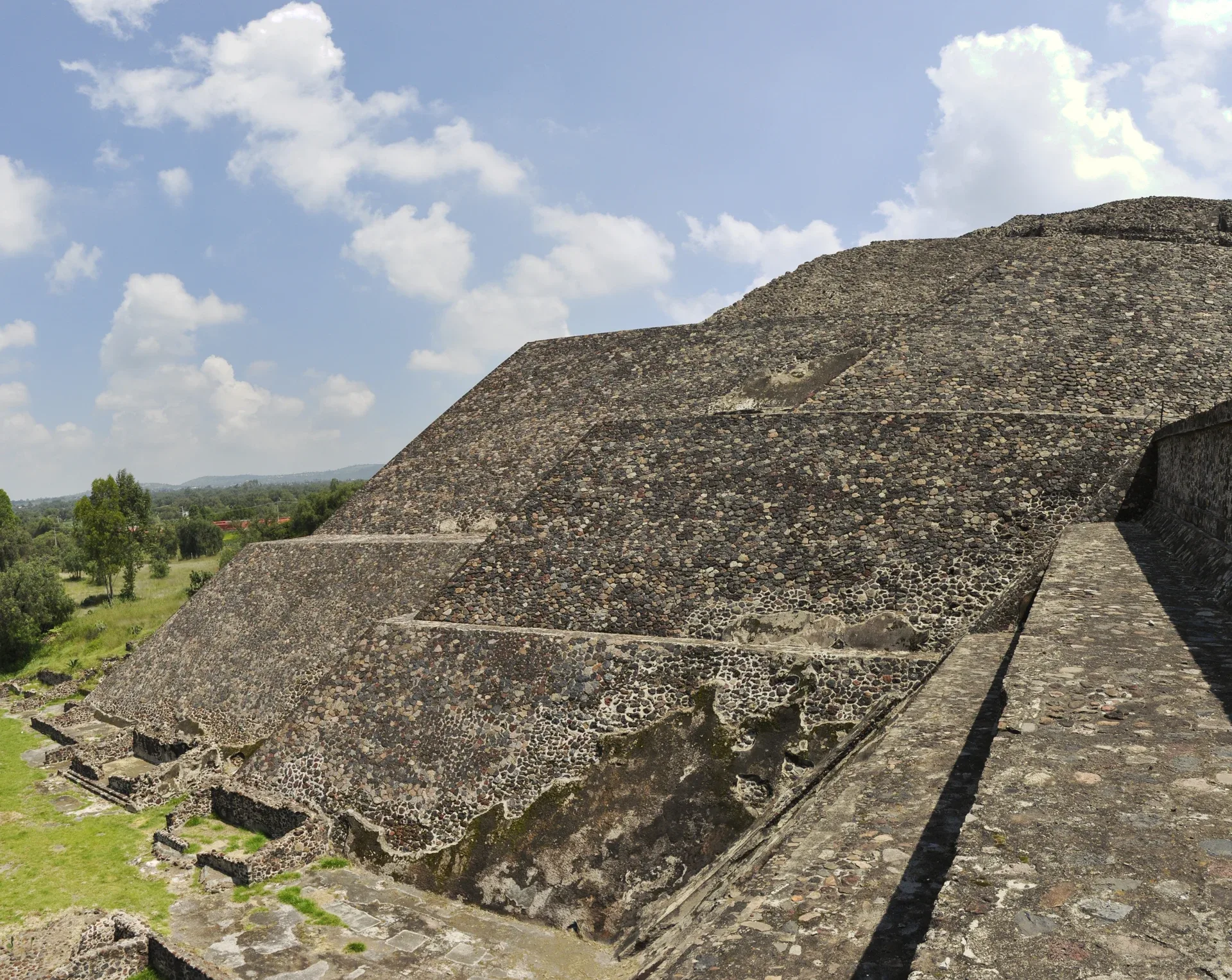
At Teotihuacán, your ticket choice mainly determines how you explore an ancient city: independently, with a group, or in conversation with a private guide. For a first visit, we would favor a guide focused on archaeology and an early-morning arrival. Advance purchase is worth comparing based on the services actually included: none of the three tours selected here lists skip-the-line access in its supplier itinerary.
The three services to distinguish
Admission gets you into the archaeological zone; transportation takes you there; a guide helps you interpret the buildings and images. These three services can be purchased together, but they meet different needs. By separating them first, you can compare an excursion from Mexico City with an independent day without being swayed by the phrase “pyramid tickets” alone.
A standard ticket suits travelers who want to read the signs, photograph the monuments and spend a long time in a museum. You choose your breaks and the order of your stops. This freedom means you need to plan the journey and prepare a few historical reference points. The site is large enough that an improvised walk can use up a lot of time going back and forth, especially if you add the murals to the major pyramids.
A guided excursion with transportation brings the day's arrangements together. Its value then depends on the time actually spent at the site, the language and the group size. Two five-hour tours can offer very different visits if one allows two and a half hours for archaeology while the other includes several meals, tastings and workshops. Check the length of the Teotihuacán stop in the detailed itinerary.
A private tour mainly offers a chance to talk and set a pace shared only with your companions. It becomes worthwhile when you have specific questions, children of different ages or a particular interest in the decorative details. Pickup from your accommodation also makes departure easier. To choose, first ask yourself what you would like to understand or see; then the extra service will have a clear purpose.
| Option | Time advertised at the site | Guide and transportation |
|---|---|---|
| Public admission only | At your own pace | Transportation to arrange; museums included subject to their opening hours |
| Morning express 364276P3 | 2 h 30 min | English- or Spanish-speaking guide; maximum 12 people; transportation depending on area |
| Group tour 193670P1 | 3 hours | English- or Spanish-speaking guide; maximum 50 people; meeting point in Mexico City |
| Private tour 205511P3 | 3 hours in the zone | English- or Spanish-speaking guide; pickup and overall duration to be confirmed |
On small screens, scroll the table sideways.
Public admission and opening hours
INAH, which manages the site, lists daily opening hours of 8 a.m. to 5 p.m., with last entry at 4:30 p.m. Arriving at that last entry time leaves very little time to see everything. We would set aside a morning for the main monuments, and a longer period if museums are a priority. These are planning suggestions, to adjust to your walking pace.
When we checked, the listed public price was 210 Mexican pesos for foreign visitors. The managing authority lists 105 pesos for nationals and foreign residents of Mexico. This distinction matters for a French traveler: a tourist stay does not count as Mexican residency. For any discount based on personal circumstances, check which documents are accepted with INAH before putting together your budget.
The official pages for the two museums described below specify that their admission is included in the archaeological zone ticket. You can therefore make room for the collections during an independent day without automatically adding a second ticket. Their own opening hours still matter: both the Museum of Teotihuacan Culture and the Museum of Murals list hours of 9 a.m.–4 p.m., while the outdoor areas stay open later.
The INAH Lugares portal mentions free Sunday admission for Mexicans. Foreign visitors traveling in Mexico should therefore not expect free admission on Sunday based on that notice alone. For reduced admission or an exemption, rely on your actual eligibility and the managing authority's response. Conditions may change; the official pages are listed in the sources so you can check before departure.
What skip-the-line access covers
A ticket purchased before your trip can make planning easier, but the term “skip-the-line” needs to be read carefully. It may refer to admission already paid for, ticket pickup arranged by an intermediary, or explicitly contracted priority access. Only the written service details tell you what you are buying. Access controls, preservation rules, and open areas continue to apply to all visitors.
The three tours recommended in this article state that their supplier itineraries do not offer skip-the-line access. We selected them for their guide, transportation, and program. The morning tour arrives around the advertised regular opening time of 8 a.m. Its early departure from Mexico City helps organize a visit early in the day; it does not provide private entry before the site opens to the public.
To compare another offer marketed as skip-the-line, look for three details: the exact admission included, the meeting point, and how the ticket is provided. A confirmation voucher may require you to find a representative, while an excursion incorporates admission into the group’s schedule. This difference matters in practice if you were planning to enter on your own earlier, use a different gate, or leave the program to visit a museum.
We would choose an advance purchase for clarity about inclusions and cancellation terms, rather than for a promise of time saved without a specific commitment. The cards link to the packages that have actually been identified. None is presented here as a way to climb a pyramid or enter a closed area: such permissions are determined by the site’s managing authority.
A small group at opening time
Tour Express 364276P3 is our first choice for a focused guided introduction to Teotihuacán. It advertises a total duration of five hours, including transportation, with about two and a half hours of guided exploration in the archaeological zone. The shared group is limited to twelve participants. This format makes it easier to talk during stops and pay attention to the explanations without following a large group of travelers.
The program provides for an early-morning pickup, between 6:30 and 7 a.m. depending on the announced arrangements, followed by arrival around 8 a.m. Several areas of Mexico City are served; outside those areas, the operator coordinates a meeting point. Confirm the final address and time for your accommodation. Getting to bed early enough will make this departure more comfortable, especially at the start of your trip.
Admission, an air-conditioned vehicle, water, and a cereal bar are among the inclusions. The guide provides commentary in English or Spanish. Have breakfast before the meeting or arrange something suitable for the journey: the advertised snack is light. The itinerary prioritizes archaeology, with a return to Mexico City after the morning’s guided visit.
For accommodation in the Centro Histórico, the listing indicates a return near the Palacio de Bellas Artes due to traffic and access conditions. Add this final leg to your schedule. We would keep lunch in Mexico City flexible, followed by an activity without a tight schedule. The advertised duration helps with planning the day; it does not guarantee a return time independent of traffic.

Viator
Teotihuacán at opening time in a small group
For a visit at opening time with no more than twelve travelers and two and a half hours of guided time at the site. English- or Spanish-speaking guide; check the return location if you are staying in the Centro Histórico.
- 5 hours
- 4.9/5 (534 reviews)
Five hours including transportation, two and a half hours guided at the site, and a maximum of twelve travelers. Admission included, English- or Spanish-speaking guide; pickup depending on the neighborhood.
Cancellation policy
For a full refund, cancel at least 24 hours before the scheduled departure date.
From MX$1,160.00
View activityChoosing a morning or afternoon departure
Offer 193670P1 provides a site-focused excursion, with morning or afternoon departure options. Its advertised total duration is five and a half hours, including a three-hour archaeological visit. It includes round-trip transportation from meeting points in Mexico City, admission, a guide, and a small snack with drinks. It is worth comparing if you would like to keep a morning free in the capital.
The group can include up to fifty people. The pace is therefore that of a group visit: traveling together, gathering as a group, and sharing commentary time. Choose this option if you are comfortable with that arrangement and the available times fit your trip better. At the meeting point, identify the guide and confirm the return instructions; this makes transitions between the different parts of the site easier.
Commentary is available in English or Spanish. Departure points have different times, depending on the time slot selected. Note the time that corresponds to your booking, then calculate your travel time from the hotel. A geographically convenient meeting point may be more comfortable than an apparently similar option that requires crossing Mexico City before the visit.
The advantage of a morning departure is that you can spend the first part of the day at the monuments and return with some flexibility. An afternoon departure lets you fit another city visit in beforehand. With this second arrangement, have lunch before departure and check how much time is actually allocated to the archaeological site. Museums close at 4 p.m., according to their official listings; make sure a museum visit is explicitly included if it matters to you.

Viator
Teotihuacán: group tour with transportation and admission
For choosing a morning or afternoon departure with three advertised hours at Teotihuacán. Admission and transportation included, English- or Spanish-speaking guide; group of up to fifty people.
- 4.9/5 (10,340 reviews)
Five and a half hours, English- or Spanish-speaking guide, and transportation from a meeting point in Mexico City; admission included.
Cancellation policy
For a full refund, cancel at least 24 hours before the scheduled departure date.
From $59.00
View activityA guide for your group
Private tour 205511P3 may appeal to travelers who want to discuss the site while keeping their group together from the departure at their accommodation. The product mentions private transportation and an English- or Spanish-speaking guide. The archaeological visit is listed as three hours, with admission included in the itinerary. The program also includes a tasting of traditional drinks; lunch is separate.
The value of a private tour becomes clear when planning what you would like to discuss. You can tell the operator that you are particularly interested in the paintings, construction techniques, or the organization of the city. For a family, specify the children’s ages and how much walking you would like to do. The operator can confirm the itinerary offered as part of the service, with access subject to what is authorized on the day of the visit.
Service to certain neighborhoods, including Santa Fe, Tlalpan, and Coyoacán, incurs an additional fee, according to the supplier. Provide your address before comparing the total cost. Also check the unit used to price the package: a search for several travelers should match your actual group. Current prices and currency are shown in the main offer and are not reproduced in the text.
The overall duration details on this listing do not make it possible to infer a consistent door-to-door schedule that accounts for the archaeological visit and travel time. Ask the operator to confirm the total time and return arrangements. We would choose this tour for the private guide and pickup at your accommodation, allowing a comfortable amount of time in the day. If you are interested in museums, mention this before purchasing to confirm how they fit into the program.

Viator
Private Teotihuacán tour from your accommodation
For exploring your questions in depth with a guide dedicated to your group and transportation from your accommodation. Confirm the total duration, service to your address, and whether museums are included; English or Spanish.
- 5/5 (2,145 reviews)
Private transportation, English- or Spanish-speaking guide, and archaeological itinerary; address, duration, and any surcharge to be confirmed.
Cancellation policy
For a full refund, cancel at least 24 hours before the scheduled departure date.
From $139.99
View activityThe guide’s language and role
A guide is especially useful at Teotihuacán because they connect elements that are spread across the site. A pyramid conveys a sense of scale; a courtyard, painted decoration, and a museum object offer insight into other aspects of society. A guide helps you move from one to another with questions: What was this space used for? How did the buildings change over time? What evidence supports a particular interpretation?
The three selected products offer guides in English or Spanish. If you would like commentary in French, look for a service that explicitly confirms this language for your date and package. We do not recommend any unverified French-language option in this selection. Choose a language in which you can follow an archaeological account and ask for clarification, beyond everyday travel conversations.
There are also unknowns in the site’s history. INAH notes that the name Teotihuacán was used by the Mexica and that the name used by its inhabitants remains unknown. A knowledgeable guide can distinguish what is established, what is an interpretation, and what research has yet to resolve. This context gives the visit depth without turning every building into a sensational mystery.
To make the most of the conversation, prepare two or three topics that genuinely interest you. The relationship between the city and its resources, the role of artisans, or how to interpret a painted animal are good starting points. On a self-guided visit, these questions are still useful when reading displays and exploring the collections. They can help you choose a museum or part of the route instead of collecting monuments with no connection between them.
A metropolis before the Mexica
Teotihuacán belongs to a period far earlier than that of the Mexica, who gave it the name by which it is known today. The INAH presentation places its peak around 350–450 CE, with a population of about one hundred thousand. This reference point changes how we read the remains: the monuments stood within a metropolis where people had to produce, trade, build, and feed a considerable population.
According to the same source, the ancient city covered about twenty square kilometers. The tourist route therefore covers only part of this urban world. Residential complexes and craft areas are just as important to its history as the great plazas. A guide can place the visible monuments within this broader setting; the collections then offer a way to approach the inhabitants through their tools, their work, and objects from everyday life.
The city’s influence reached other regions of Mesoamerica. The INAH describes commercial and political relations with distant places, including Tikal in present-day Guatemala. It also mentions neighborhoods inhabited by people from elsewhere, particularly Zapotecs from present-day Oaxaca. This diversity invites questions about the movement of people, materials, and techniques, rather than the idea of an isolated city centered on its temples.
For a first visit, keep a few simple reference points in mind: a large city, a history spanning several centuries, and long-distance connections. You can relate them to the buildings and objects you encounter without memorizing a succession of reigns. The pyramids’ and complexes’ present-day names help you find your way; their functions and development are understood through archaeological research. It is these connections that make time spent with a guide worthwhile.
La Ciudadela and the Feathered Serpent
La Ciudadela is an excellent starting point for understanding the scale of the city. The INAH describes a complex enclosed by a large platform, around a vast space that includes a plaza, a central sanctuary, and residential units. The Temple of the Feathered Serpent occupies a prominent place there. First, you can take in the overall layout, then focus your attention on the carved decoration from the areas open to visitors.
The heads and repeated motifs give the building a presence very different from the great masses of the Sun and Moon. The official description notes alternating sculptures, serpents depicted in profile, and a repertoire of marine elements. Traces of polychromy remind us that the stone visible today was part of a colorful architectural setting. A guide can help you identify the forms before discussing their interpretations.
This is also a good place to observe talud-tablero, a recurring combination in Teotihuacan architecture. The talud is the sloping part of the wall; the tablero is the vertical panel above it. Once you understand this vocabulary, you can spot it elsewhere along the route. Your view thus shifts from a succession of terraces to a recognizable building system.
Give this complex a proper stop if the reliefs interest you. A quick photo from a distance does not always capture their details. If you are taking a guided tour, ask before booking whether La Ciudadela is included in the actual route and where the entrance is. The agreed itinerary should match your priorities; local conditions may then require the guide to adjust the route.
From the Sun to the Plaza of the Moon
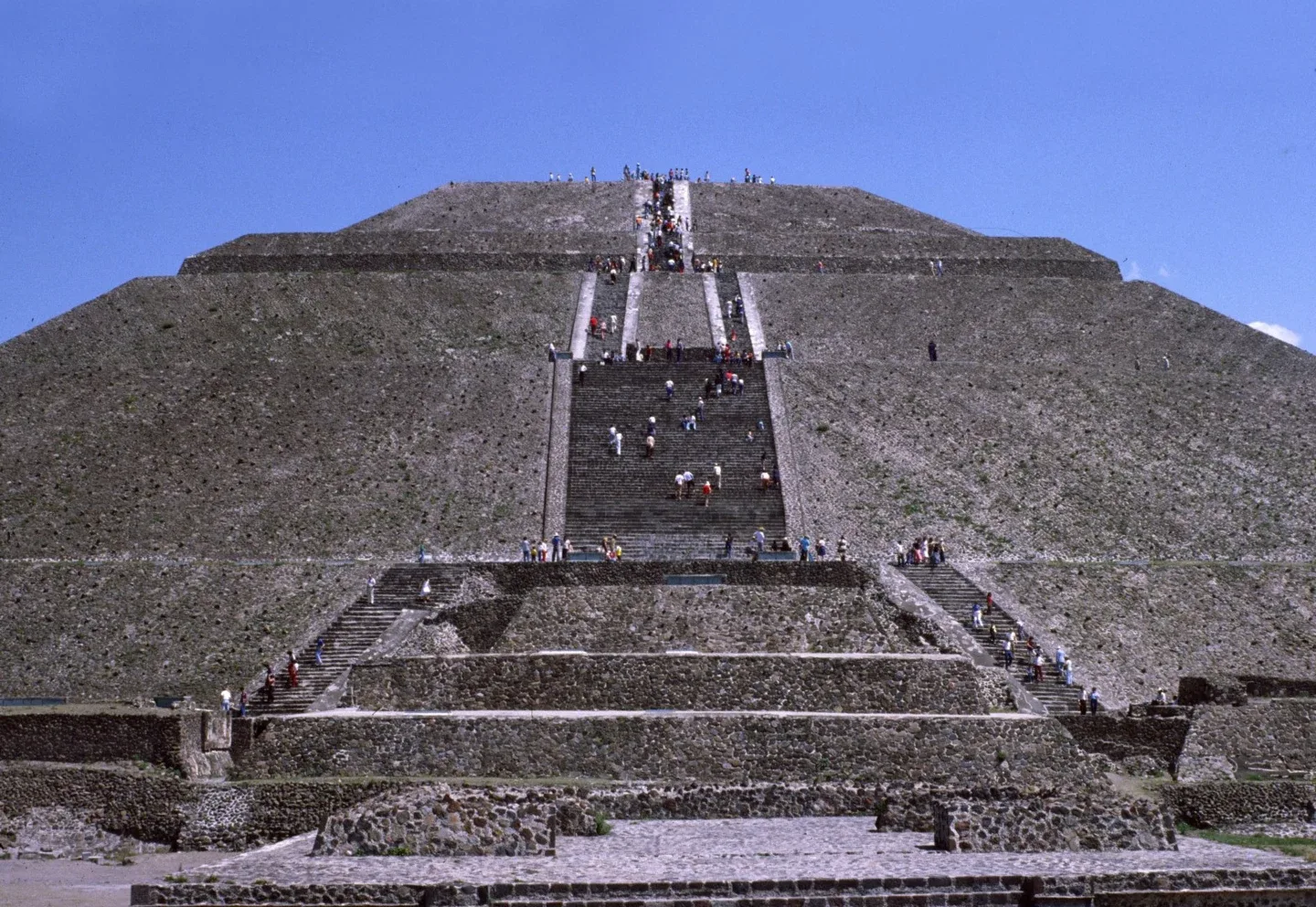
The Pyramid of the Sun gives you a sense of the city’s monumental ambition. The INAH information sheet gives its height as 65 meters and its base as 224 meters on each side. These proportions become clear if you step back, then compare the terraces with the surrounding spaces. The complex also includes a plaza, smaller structures, and residential areas: you are moving through an urban layout with several functions around the main monument.
The Avenue of the Dead serves as a landmark connecting the major complexes. The route involves walking and crossing changes in elevation. Plan for stops to look around rather than one continuous walk to the next photo spot. The views, platforms, and courtyards let you see how the buildings relate to one another, even when some access points are closed.
Near the Plaza of the Moon, the Palace of Quetzalpapálotl offers a change of scale. The INAH places it at the southwest corner of the plaza and describes the bird reliefs adorning the pillars in its courtyard. The painted decorations and geometric motifs invite you to slow down. After taking in the broad views, you can choose to focus on an architectural detail, varying the way you explore without adding an outside activity.
The Patio of the Jaguars is west of the palace. Its description mentions felines associated with conch shells and elaborate ornaments. These images let you ask more specific questions about the animals and signs found in the city. Follow the open routes and respect the protections around the decorations. The visit does not guarantee that you can climb anything: INAH rules and staff instructions take precedence over old commercial descriptions.


The Museum of Teotihuacan Culture
The museum is south of the Pyramid of the Sun; its information sheet indicates access through Gate 5. It brings together more than six hundred objects across eight galleries. Topics include the environment, social organization, the economy, technologies, and religious practices. For travelers who want to understand life in the city, this stop usefully complements seeing the buildings.
The materials offer another way to read the site: ceramics, stone, bone, shell, and obsidian bring the inhabitants’ work to the fore. Take time to consider the objects’ suggested uses and their context rather than looking only for the most spectacular pieces. Long-distance trade and relationships with other peoples become more tangible when you connect them to products and resources.
The scale model of the city lets you look back on the route you have already taken or plan what comes next. The INAH highlights the feature that pairs this model with a window overlooking the Pyramid of the Sun. After several hours among the remains, this change of perspective helps organize your bearings. You can identify the complexes you have seen and understand what lies beyond your walk.
For planning, note the museum’s own hours, 9 a.m. to 4 p.m., and that admission is included in the site ticket. We would set aside a dedicated time slot for the museum rather than squeeze it into the final few minutes. On an excursion, ask whether entry to the building is actually part of the tour or whether the itinerary remains outdoors. An independent day visit lets you give it more time, depending on your interests.
The Paintings of Beatriz de la Fuente
The Beatriz de la Fuente Museum of Teotihuacan Mural Painting is listed near Gate 3. It offers an entry into the world of color, signs, and techniques of the ancient city. The fragments on display help move beyond the image of a uniformly gray landscape. Buildings featured decorative schemes, and surviving remains and reproductions provide clues to understanding them.
The official exhibition is organized around nine themes across thirteen galleries, with fragments of paintings, models, and other archaeological objects. Topics include painting techniques, chronology, urban orientation, and Teotihuacan writing. The writing remains only partially deciphered, so the panels and explanations distinguish observations from interpretations proposed by researchers.
We would prioritize this museum if you enjoy looking closely at details and understanding how an image works. An animal, a plant, a human figure, or a repeated shape can be compared with motifs found in the architectural complexes. The reproduction of the portico at Tepantitla, included in the exhibition, also gives an idea of the role painting played in a built space.
The museum lists its hours as 9 a.m.–4 p.m., with admission included in the site ticket. Its location and earlier closing time should factor into your route. On a first-day visit, it may be better to explore one museum in depth than rush through both. Choose the Museum of Teotihuacan Culture for society and objects; choose Beatriz de la Fuente for decorations, techniques, and signs.
An Independent Day Trip by Bus
Autobuses Teotihuacan lists its ticket counter at Central del Norte, platform 7, in the terminal at Eje Central Lázaro Cárdenas 271. The company says payment at this counter is by cash. Allow plenty of time to reach the terminal, then ask for the service to the archaeological zone and the drop-off gate. Keep your ticket and the information you need for the return trip close at hand.
The carrier’s FAQ mentions drop-offs at Gates 1 and 2 and a return pickup to Mexico City at Gate 2. Let this last detail guide the end of your visit. If you finish at the Museum of Murals or near another entrance, allow time to get back to the bus departure point. When you arrive, check the exact pickup location and that day’s service information.
The carrier gives an approximate journey time of sixty minutes in normal traffic. Add your trip from your hotel to the terminal, the wait before departure, and the time needed to enter the site. For the return, the advertised frequency of every fifteen minutes is a guideline to confirm on site. The ticket counter’s opening hours do not tell you when the last bus leaves the pyramids.
This arrangement works if you want to spend several hours exploring the collections or adjust your walking route freely. Prepare a shorter version of your itinerary so you can stop when you get tired. A self-guided admission and public transport leave the planning up to you; by contrast, the three excursions linked in this article organize transport around their own schedules and terms.
Pacing and what to bring
For a first self-guided visit, we suggest starting at the Ciudadela, heading to the Sun sector, then continuing to the Plaza of the Moon depending on which routes are open. Fit your chosen museum into this progression based on its location and its 4 p.m. closing time. This is a suggested itinerary, with no guaranteed walking times and no obligation to see everything.
Arriving early makes it easier to spread out your stops comfortably. Check the weather for the day and adjust what you bring: a hat, sun protection, water, and shoes that stay securely on your feet. An extra layer may be useful if you leave Mexico City early. Bring a bag light enough to carry while walking and practical enough to let you take out your water without unpacking everything.
The guidelines published by INAH notably prohibit bringing food, pets, and tobacco into the areas concerned. Plan to eat outside the visit and follow staff instructions regarding the items you bring. Flash photography is prohibited in the museums. View objects and paintings from a distance, behind the protective barriers, even when a detail seems difficult to photograph.
With children, alternate a broad vista with a small observation goal: a bird on a pillar, a sculpted head, or an object connected with everyday life. If someone in your party has difficulty walking, describe their needs to the operator before booking: distances, changes in level, getting into the vehicle, and breaks. A private option lets you discuss these needs in detail; arrangements must be confirmed for the chosen itinerary.
Visit budget
For a self-guided visit, budget for the zone admission, round-trip transport, travel within Mexico City, and a meal. The two museums mentioned are listed as included with archaeological-site admission. You can therefore compare them based on the time you have rather than on an assumed extra charge. Check transport prices with the company; we do not treat an old blog price as a current fare.
For excursions, compare the same group size and the same services. The early small-group tour includes pickup in a defined area, while the group tour uses meeting points. For the private option, check the exact service area and any additional charges. The time saved on planning may justify your choice, even if you could have reached the site on your own.
Activity prices and ratings appear on the cards when a supplier snapshot provides them. The amount depends on the currency returned and the terms of the selected option. Check the summary before payment to see your group’s total, what is included, and the cancellation terms. An activity being active in the catalogue does not guarantee availability on any particular date.
For a first guided overview, we recommend the small group at opening time. Independent travel is better suited to a long museum visit; the private option is worth the budget if you have a particular interest and want a pace discussed in advance. If your only priority is avoiding buying admission on site, first compare the exact service offered. The term “skip-the-line,” by itself, tells you nothing about the route or the quality of the guidance.
FAQ
Which ticket should you buy for a first visit to Teotihuacán?
A site ticket is enough to explore the open areas and included museums, while arranging your own transport. If you want a guide, choose a tour that specifies substantial time at the archaeological site and a language you understand. The early small-group tour selected here includes two and a half hours of guided time on site, admission, and transport from Mexico City, subject to its pickup area.
Is skip-the-line access essential at Teotihuacán?
We do not consider it the most important criterion. The supplier itineraries for all three tours in this article state that they do not include skip-the-line access. They provide a guide and transport arrangements. For an offer using that label, check whether it guarantees priority access or simply a prepaid ticket, as well as the meeting point and ticket handover arrangements.
Does the ticket include the museums?
The official listings for the Museum of Teotihuacan Culture and the Beatriz de la Fuente Museum of Murals say that admission is included in the cost of entry to the archaeological zone. They list opening hours of 9 a.m. to 4 p.m. For an excursion, also check that the itinerary allows time in the museum you want to visit: included admission and an actual planned museum visit are two separate things.
Is admission free on Sundays for a French tourist?
The site’s official page mentions free Sunday admission for Mexicans. French tourists should not assume that this means they can enter for free. The public pricing distinguishes foreign visitors from categories charged a different rate, including foreigners residing in Mexico. To find out whether you qualify for a personal discount and what documents are required, contact the site’s management directly.
Can you climb to the tops of the pyramids?
Plan your day around the permitted routes and viewing the monuments, without assuming that a climb will be allowed. Access is subject to the rules enforced by INAH and staff instructions on the day of your visit. Some commercial descriptions still mention climbs; they do not constitute authorization from the site’s management. None of the recommendations in this comparison relies on a promise that the summit will be accessible.
How much time should you allow for the visit?
A morning gives you time to plan a visit to the main complexes at a pace that suits you. Allow a longer time slot if you want to explore a museum and its decorations in depth. The selected excursions advertise two and a half or three hours at the archaeological zone, as part of an outing that also includes travel. If you go independently, factor in the distances, breaks, and the museums’ 4 p.m. closing time.
Is there a French-language tour in this selection?
The three recommended products offer an English- or Spanish-speaking guide. To take the tour in French, choose another service that confirms French for the selected option and your date. If you book in English or Spanish, make sure you are comfortable enough to understand the historical explanations. If you visit independently, the official listings already provide information to help you prepare the main points before you set off.
Where do you catch the return bus to Mexico City?
Autobuses Teotihuacan lists Gate 2 of the archaeological zone as the pickup point for buses back to Mexico City. Confirm the exact location when you arrive and ask about departures on the day of your visit. Allow time to reach this gate from the last area you visit. The carrier estimates a journey time of about one hour in normal traffic; then add your trip from the terminal to your accommodation.
Does the early departure let you enter before opening time?
The Express product described here advertises an arrival at around 8 a.m., the usual opening time published by INAH. Its benefits are the small group, organized transport, and an early visit. It should not be described as offering private access before opening. Your pickup time from your accommodation depends on the service area and must be confirmed with the operator.
Which option should you choose for the murals?
A self-guided day offers the greatest freedom to visit Beatriz de la Fuente and observe the accessible settings within the architectural complexes. A private tour may also be suitable if the operator confirms that this is included in the itinerary. The museum presents fragments, techniques, and interpretations, while the Palace of Quetzalpapálotl and the Patio of the Jaguars place motifs in their architectural context. Plan these stops before the collections close.
Sources and checks
Plan your visits and check current conditions.
- Teotihuacán: admission and public price ↗
INAH · Accessed October 31, 2026
What this source supports
Open daily 8 a.m.–5 p.m., last entry 4:30 p.m.; foreign visitor price MXN 210, nationals and foreign residents of Mexico MXN 105. Name used by the Mexica; original name unknown.
- Teotihuacán: city, monuments and visitor guidelines ↗
INAH — Lugares · Accessed October 31, 2026
What this source supports
Peak period around 350–450, approximately 100,000 inhabitants and an ancient city covering 20 km²; connections with Tikal and foreign neighborhoods; talud-tablero, Ciudadela, Feathered Serpent, Sun, Quetzalpapálotl and Patio of the Jaguars. Sun Pyramid 65 m tall with a 224 m square base. Sunday admission mentioned as free for Mexicans, museums included; guidelines on food, animals and smoking. No access to the summit guaranteed.
- Museum of Teotihuacan Culture ↗
INAH — Lugares · Accessed October 31, 2026
What this source supports
9 a.m.–4 p.m. daily; cost included in the site admission; south of the Sun Pyramid, Gate 5; more than 600 objects and eight galleries, a scale model and a window overlooking the pyramid.
- Beatriz de la Fuente Museum of Murals ↗
INAH — Lugares · Accessed October 31, 2026
What this source supports
9 a.m.–4 p.m. daily; cost included in the site admission; Gate 3; nine themes and thirteen galleries; fragments, painting techniques, writing that has only been partially deciphered and a reproduction of the portico of Tepantitla's Building 25.
- Autobuses Teotihuacan: terminals ↗
Autobuses Teotihuacan · Accessed October 31, 2026
What this source supports
Central del Norte, Eje Central Lázaro Cárdenas 271, ticket counter at platform 7; cash. The ticket counter's opening hours are not assumed to match the departure times of every service.
- Autobuses Teotihuacan: frequently asked questions ↗
Autobuses Teotihuacan · Accessed October 31, 2026
What this source supports
Drop-off at Gates 1 and 2; return from Gate 2; 60-minute journey in normal traffic, with return service advertised every 15 minutes—confirm on site. No last bus time or fare invented.
- Teotihuacán at opening time in a small group ↗
Viator Partner API / operator · Accessed October 31, 2026
What this source supports
Active product, five hours in total, 150 minutes of guided time, maximum twelve people, English/Spanish, admission and transportation included depending on area; arrival advertised around 8 a.m., no skip-the-line access. Return to Centro Histórico near Bellas Artes. Actual product GET reviewed; deep link received for our account, supplier photo of the exact product; no live availability guaranteed.
- Teotihuacán: group tour with transportation and admission ↗
Viator Partner API / operator · Accessed October 31, 2026
What this source supports
Active product, 330 minutes total and 180 minutes at the site, maximum fifty people, English/Spanish; admission, transportation from the meeting point and a snack included; no skip-the-line access. Actual product GET reviewed; deep link received for our account, supplier photo of the exact product; no live availability guaranteed.
- Teotihuacán privately from your accommodation ↗
Viator Partner API / operator · Accessed October 31, 2026
What this source supports
Active private product, English/Spanish, 180-minute site visit with admission YES, private transportation, tasting, lunch excluded, service-area surcharges. Overall catalog duration of 60–300 minutes is inconsistent with the individual stops: confirm, no door-to-door schedule promised. No skip-the-line access. Actual product GET reviewed; deep link received for our account, supplier photo of the exact product; no live availability guaranteed.
Viator — activity pages
Source for the activity information below.Affiliate links: Odyvero may earn a commission when you book through this article’s buttons.
- Private Teotihuacán tour from your accommodation ↗
Accessed October 31, 2026
- Teotihuacán at opening time in a small group ↗
Accessed November 1, 2026
- Teotihuacán: group tour with transportation and admission ↗
Accessed October 31, 2026


