 odyvero
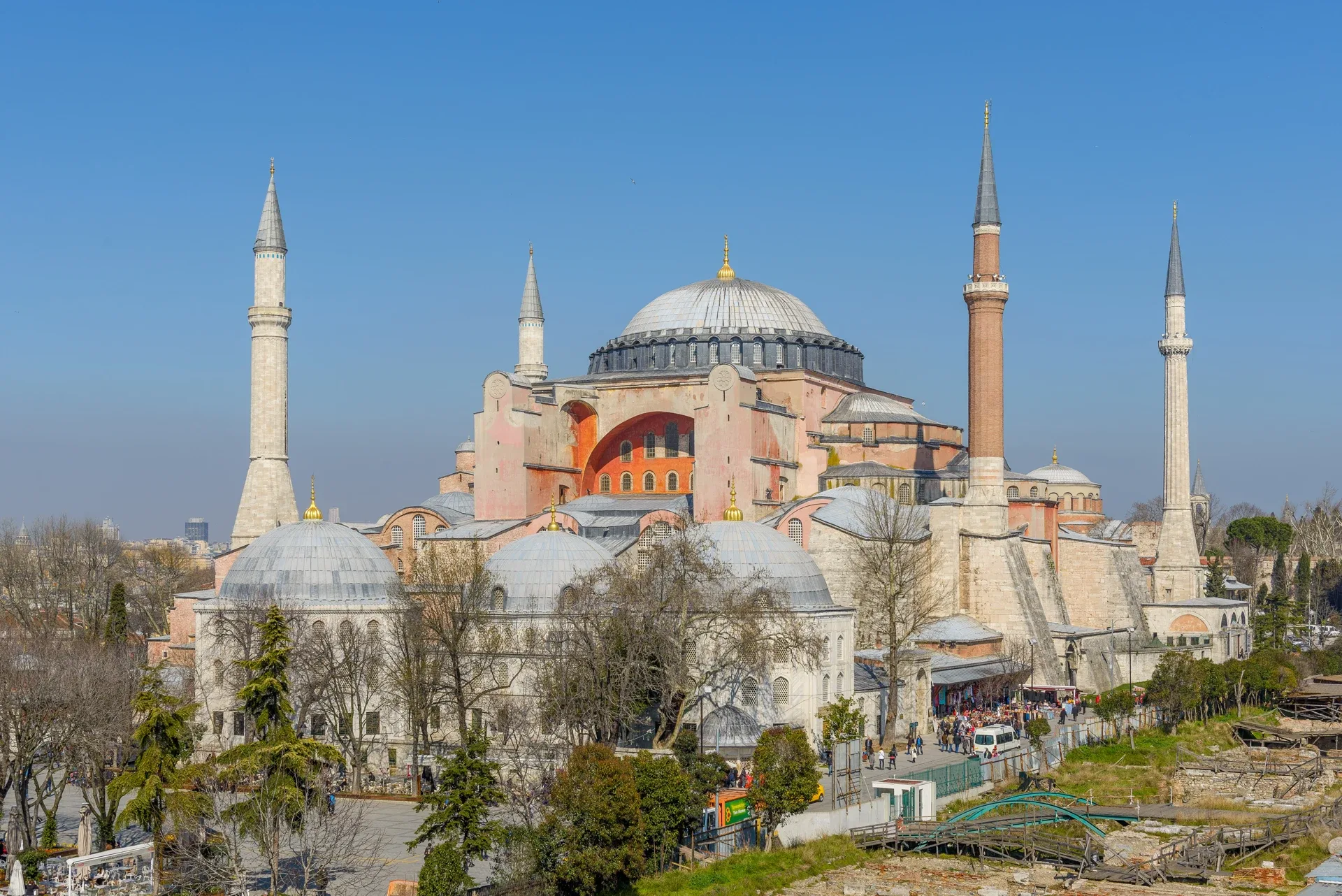
To visit Hagia Sophia, first choose how you want to explore it: a ticket to visit the galleries at your own pace, a guide focused on the monument, or a walking tour combining Sultanahmet’s sites. Paid tourist access is separate from the prayer hall. Booking a ticket mainly saves you from buying one at the ticket office; security checks are still mandatory. Here’s how to compare the options, their included admissions, and the language of the explanations—without paying twice for the same service.
The Gallery and Prayer
At Hagia Sophia, the ticket question begins with the route. Visitors coming to discover the monument follow the tourist route through the upper galleries. The ground floor retains its function as a place of prayer. This arrangement explains why you may read that a ticket is required for the same building while access for worship remains separate. When planning a heritage visit, consider the tourist access being sold and the areas it actually allows you to visit.
From the galleries, the appeal lies as much in the decoration as in the view of the great hall. The openings, arches, and columns reveal the building’s layout from above. The Byzantine mosaics are another reason to visit. You can observe an architecture that has been transformed several times, in which Ottoman interventions and contemporary uses play an essential role. The route open to visitors may change with the works and the manager’s decisions.
A guide or audio guide can help you identify these different layers. Before booking, however, check the advertised itinerary: commentary inside the monument, an introduction in the square followed by free time, or a guided visit to several sites. “Guided” can describe several different arrangements. For a traveler who wants to ask questions in front of the mosaics, this detail matters more than the word “priority” in the commercial title.
The resumption of worship in 2020 is part of the site’s recent history. It is reflected in dress requirements, the need to respect silence, and visitor circulation. Older descriptions of the museum can still help explain a work of art, but they are not enough to prepare for a visit today. A passage shown in an old photograph may now be part of a different route or temporarily inaccessible.
What “Skip-the-Line” Means
A visit to a monument involves several stages: obtaining your admission ticket, finding the correct entrance, going through security checks, and moving through the areas open to visitors. A ticket purchased before your visit mainly affects the first stage. You have already paid, or your operator holds the group’s tickets. On arrival, you then follow the presentation or collection instructions specified in your booking.
Security checks apply to visitors with guides and independent visitors alike. Several operators in our selection explicitly state that their guides help organize the visit without eliminating waits at the mosques. We would therefore not recommend any option on the promise of immediate entry. Group size, arriving on time for the meeting point, and clear information about what is included provide a much more reliable basis for comparison.
The booking voucher also deserves careful attention. It may help you find the guide who will give you your tickets, rather than let you go straight through a turnstile. This distinction becomes crucial when the meeting point is elsewhere on the square. Arriving at Hagia Sophia with only your voucher when the tour starts from a nearby kiosk could mean missing the group, even though the monument is just a few minutes away.
To assess the value of booking ahead, consider what it actually makes easier. A self-guided ticket lets you choose your departure time and pace, subject to its terms. A guided tour adds a meeting time and a shared itinerary, but takes care of coordinating the stops. No specific waiting time can be inferred from the label “skip-the-line” alone, and a private guide is still subject to security decisions.
The options at a glance
The four selected activities meet different needs. Two include admission to Hagia Sophia; the two private services charge mainly for the guide and require you to arrange admission separately. The self-guided ticket remains an option for travelers who want to devote most of their budget to admission and explore the monument without a group schedule.
| Option | Advertised duration | Verified language | Hagia Sophia admission |
|---|---|---|---|
| Self-guided tourist ticket | Your own pace | Depending on the chosen interpretation tool | What you are paying for |
| Private guide focused on Hagia Sophia | 40 minutes | English | Payable separately |
| Hagia Sophia and the Blue Mosque in a group | 2 h 30 | English or German, depending on the option | Included |
| Two mosques and the Basilica Cistern | 3 hours | English or German, depending on the option | Included, as is the cistern |
| Private guide to the Old Town | About 7 hours for the one-day option | English or Spanish | Payable separately |
On small screens, scroll the table sideways.
Tour durations include the other stops and travel between them. They do not indicate the time spent inside Hagia Sophia alone. The languages listed match the pages we actually checked; none of the four activities advertised a French-language tour here. For longer tours, make sure you select the option described: the same listing may offer several durations, departure points, or group sizes.
The self-guided ticket
A self-guided ticket suits you if you like to read before your visit, spend a long time observing a detail, or explore without following a group. You can prepare a few historical reference points, then focus on the spaces and works actually visible. This option works particularly well for a stay in which the other monuments of Sultanahmet are already spread across several days.
When purchasing, identify the exact product: admission to the monument, an introduction by a guide, a possible audio guide, or a ticket to a nearby museum. Hagia Sophia also has a separate History Museum, with an audiovisual experience. Its very similar name may make it seem as though all offers cover the same entrance. A booking for the History Museum must list admission to the mosque separately if you want to visit both.
The Muze.gen.tr specialist guide page showed a tourist admission ticket for 25 euros when we checked. This gives you a reference point for distinguishing admission fees from guide fees. Check the price, age categories, and associated services again on the sales channel you choose before paying. Prices for guided activities appear on their listing cards and may use a different pricing basis.
To make the most of exploring independently, prepare a short list of things to look at rather than a timed route. The dome, the marble, a mosaic, and the relationship between the galleries and the central hall are enough to structure a first look. You can linger over what interests you and adjust your route to the areas open that day. Personal headphones and a charged phone are useful if your interpretation relies on an app; check its language and make sure it works before entering.
The dome and the marble
The present building was erected in the 6th century under Justinian and inaugurated in 537. Its architectural significance becomes clear when you follow how the great supports carry the arches and then the dome. Curved forms echo one another at different heights. This interplay of volumes helps explain why Hagia Sophia has held such an important place in the history of religious architecture and in the landscape of Istanbul.
A guide can make this easier to understand without piling on dates. Start by observing the pillars and arches in front of you, then follow the transition to the roof structure. The pendentives—the curved surfaces that provide the transition to the dome’s circular base—become easier to understand when you place them in the space around you. With a guide, you can ask where to look and how to recognize the different parts, depending on what remains visible during restoration.
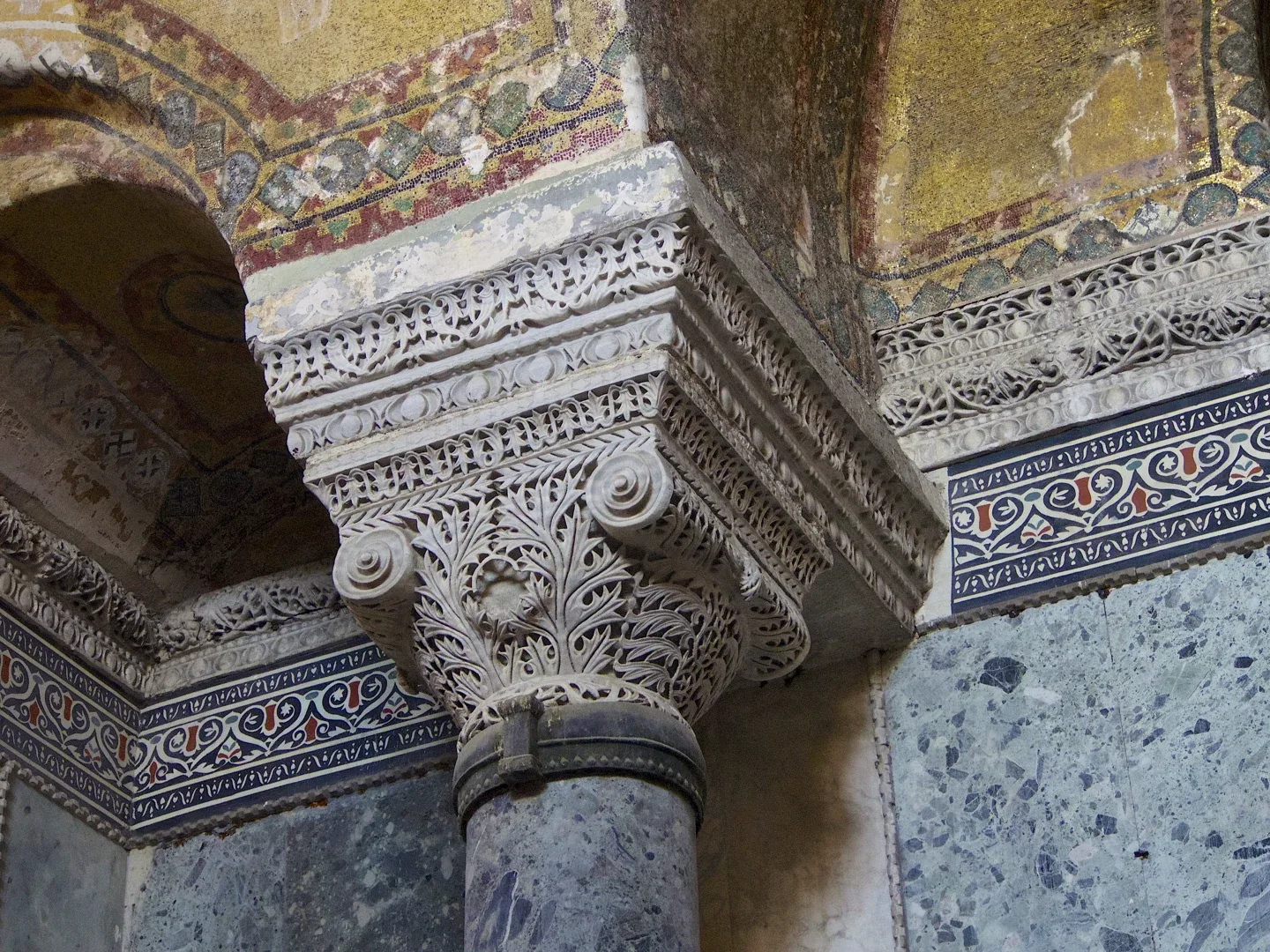
The marble deserves time too. The facings combine colors and veins whose arrangement contributes to the decoration. On the supports and capitals, the carving has a different effect: vegetal motifs, openwork surfaces, and reliefs can be read at closer range. An attentive visit therefore alternates between overall views and details, rather than devoting all your attention to a single photograph beneath the dome.
The large calligraphic disks and the features associated with worship recall the Ottoman transformations. For a first visit, we would favor an explanation that connects these elements to the building’s history rather than one devoted exclusively to its earliest period. This is also a reason to compare Hagia Sophia with the Blue Mosque: in the same neighborhood, you will discover two building histories and two approaches to organizing decoration.
The eras of Hagia Sophia
The name Hagia Sophia refers to Divine Wisdom. Here, it denotes a place of worship whose successive buildings occupied the same site. The first two churches, which predated the current building, disappeared after fires and unrest. The destruction of the second during the Nika revolt in 532 preceded Justinian’s commission. This chronology provides an initial point of reference for your visit: the monument you see belongs to a particularly ambitious reconstruction of the imperial capital.
The construction of the current church is associated with Anthemius of Tralles and Isidore of Miletus. It was consecrated in 537, after about five years of construction. The main thing to notice on site is the interplay between a vast longitudinal space and a dominant central dome. Stability problems, earthquakes, and repairs later made the building a construction site spanning several eras. The appearance you see is thus the result of successive construction, alterations, and reinforcements.
The figurative decorations do not all date from the time of the building’s foundation. The mosaics in the galleries, in particular, belong to different periods of the Byzantine Empire. The Crusaders’ sack of Constantinople in 1204 marks another turning point in the history of the monument and the city. A guided visit can put these events in context without conflating the age of an image, the wall that bears it, and the overall structure. When viewing the galleries, this distinction is often more useful than memorizing a sequence of dates.
After the Ottoman conquest of 1453, Mehmed II converted Hagia Sophia into a mosque. Additions related to this new use included facilities for worship and minarets, built or modified over the course of successive reigns. The complex also gained buildings and amenities around the main structure. Conservation work and major later restorations have, in turn, become part of the site’s history, rather than simply representing a contrast between two fixed states.
In the nineteenth century, the work of the Fossati brothers and the large calligraphic medallions provided still more points of reference. Its conversion into a museum, which opened in 1935, encouraged a heritage-focused interpretation that travel guides continued to present for many years. Since 2020, Hagia Sophia has once again functioned as a mosque. For today’s visitor, these successive functions shed light on the decorations, while current access arrangements determine the route: a good visit connects both dimensions, historical and practical.
The Gallery Mosaics
The Deesis is among the best-known ensembles in the galleries. It depicts Christ, the Virgin Mary, and John the Baptist. A useful commentary identifies the scene, explains its religious role, and helps you interpret the surviving sections. You are looking at a fragmentary work: what is missing also shapes how the ensemble has come down to us. A guide can provide context that goes beyond simply naming the figures.
The panels associated with Empress Zoe and the Komnenos family introduce another dimension: the links between sacred images, imperial representation, and donations. They make it possible to approach Hagia Sophia as a place of power as well as worship. For a traveler passionate about Byzantine history, these ensembles may justify a visit focused more closely on the galleries rather than a tour covering four or five monuments.
Before choosing a guide, be clear about what you are looking for. Are you mainly hoping to understand the construction, distinguish between periods, or look at the mosaics? On a private tour, that priority may shape the commentary if the route allows. On a shared tour, the program has to accommodate the whole group and also allows time for the other stops. These two formats lead to different visits, even when the ticket on offer is the same.
Restoration work and visitor circulation can change where you can view the artworks from. The works described in historical guides can therefore help you prepare your eye, but they are not a guaranteed list of rooms you will be able to visit on your date. If a particular mosaic is the reason for your visit, ask the operator whether its area is currently part of the accessible route. This check is especially useful before booking a themed tour or a short private session.
The Forty-Minute Private Guide
The Hagia Sophia activity, listed under reference 165880P3, offers a private English-speaking guide and lasts forty minutes. It is aimed at travelers who want to focus on this monument without booking a half-day shared tour. Admission is listed among the exclusions; the operator says it can be paid to the guide, subject to their arrangements. Add this expense to the cost of the tour when comparing the total price.
The short format gives your visit a clear focus. Before the meeting, you can mention your interest in Byzantine construction, the mosaics, or Ottoman transformations. One-on-one interaction makes it easier to ask a question or revisit an explanation. However, you need to be comfortable following the commentary in English: for a history-focused visit, understanding the words on your ticket is not always enough to make the most of the guide’s explanations.
Forty minutes means making choices. We would prioritize explaining a few elements well over listing every decoration. Ask how the time is divided between the introduction, entry, and commentary, and whether you can spend some free time in the galleries afterward. The listing gives the overall duration; it does not mean that every minute will be spent looking at an artwork.
This option makes particular sense if you have already arranged to visit the Blue Mosque or the Basilica Cistern separately. It avoids buying another neighborhood tour just to get explanations about Hagia Sophia. For a couple or an English-speaking family, compare the displayed base price with the exact group size: the price of a private tour and the per-person price of an outing are not calculated in the same way.

Viator
Hagia Sophia with an English-speaking private guide
For focused explanations of Hagia Sophia and the chance to ask questions in English. Add the admission ticket to your budget and confirm how the commentary is structured before booking.
- 5/5 (101 reviews)
40 minutes of private accompaniment in English. Hagia Sophia admission must be paid separately under the operator’s terms. Check mobility restrictions for the gallery.
Cancellation policy
For a full refund, cancel at least 24 hours before the scheduled departure date.
From €42.85
View activityTwo Mosques in a Small Group
Tour 51192P70 brings together Hagia Sophia, the Blue Mosque, and points of interest in the Hippodrome area over two and a half hours. Admission to Hagia Sophia is included. The tour is offered in English or German, depending on the option selected. It suits first-time visitors to the neighborhood who want to connect the monuments rather than plan each one separately.
Bringing the two mosques together gives the tour a clear theme. Hagia Sophia originated as a Byzantine building transformed over the centuries; the Blue Mosque was commissioned by an Ottoman sultan in the early seventeenth century. The guide can compare their volumes, decorations, and positions around the same square. A walk through the former Hippodrome adds a public space to this religious and architectural perspective.
The general description for reference 51192P70 mentions a small group of fifteen travelers, but it also offers an option for up to twenty-four participants. So check the capacity of the option you select. Departures from Sultanahmet and Galataport also have different meeting points; the operator reserves the Galataport option for cruise passengers. Travel to the meeting point is not included in the base price.
According to the listing, children under seven are not admitted to this activity. For other travelers, the itinerary involves walking between sites and keeping to a shared schedule. We would choose this outing for the start of your stay, then leave the rest of the day for lunch and a relaxed return to the neighborhood. You will then have the context to distinguish the buildings without immediately having to follow up with another long indoor visit.

Viator
Hagia Sophia and the Blue Mosque with ticket
For a first half-day in Sultanahmet, to connect the two monuments. Check the language and capacity of the option: the listing also offers a group of up to twenty-four people.
- 4.8/5 (509 reviews)
Two and a half hours, in English or German depending on the option; Hagia Sophia ticket included. Children under seven are not admitted. Select the group and departure options; transport to the meeting point is separate.
Cancellation policy
For a full refund, cancel at least 24 hours before the scheduled departure date.
From €39.00
View activity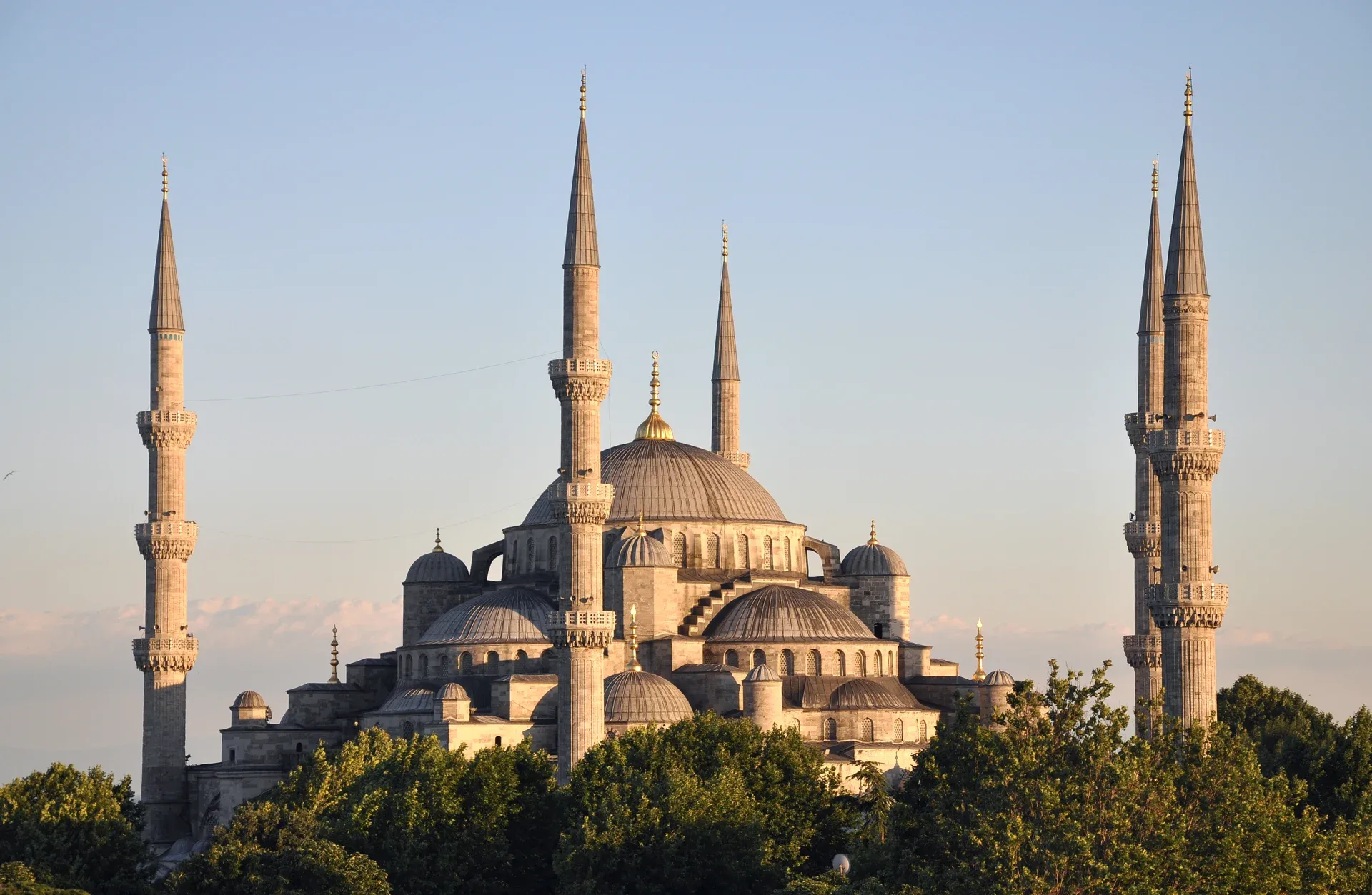


The Cistern as a Third Stop
With reference 51192P216, the three-hour tour adds the Basilica Cistern to the two mosques. Tickets for Hagia Sophia and the cistern are included. The activity offers English or German guiding and sets a maximum group size of twenty travelers. It suits a specific goal: seeing, on one outing, a Byzantine monument turned into a mosque, an Ottoman imperial mosque, and an underground structure from Constantinople.
Inside the cistern, the way you experience the site changes. The columns, water, and sculpted bases shift attention to the city’s water supply and the reuse of materials. This stop usefully complements the perspective on Hagia Sophia, built under the same emperor as the cistern. It also adds variety to a visit in which the first two monuments already demand a lot of visual attention.
The extra time is spread across the whole itinerary. The advertised three hours include travel between sites, presentations, and admissions. If you want to study the mosaics at length, a visit focused on Hagia Sophia is a better fit. For a first historical half-day, however, having both tickets included simplifies the budget and the logistics of paid entry.
The operator asks guests to arrive fifteen minutes before departure and does not admit children under seven. It also plans to visit the Theodosius Cistern or Binbirdirek Cistern if the Basilica Cistern is closed. If the Medusa heads in the Basilica Cistern are your priority, factor in this possible replacement when deciding. Also choose the correct departure option; the Sultanahmet meeting point is not the same as the one offered to cruise passengers.

Viator
Hagia Sophia, the Blue Mosque, and the Basilica Cistern
To visit both mosques and the Basilica Cistern with paid admission included. Allow three hours for the full tour; check the meeting point and the possibility of a substitute cistern.
- 4.9/5 (181 reviews)
Three hours, in English or German, with a maximum of 20 travelers. Hagia Sophia and cistern tickets included. Ages seven and up; arrive 15 minutes early. An alternative cistern may be offered if it is closed.
Cancellation policy
For a full refund, cancel at least 24 hours before the scheduled departure date.
From €114.00
View activityA day with a private guide
Reference 11522P1 offers private guiding for one, two, or three days. For a visit to the old city, we have selected the one-day option, which lasts around seven hours. The guide is listed as speaking English or Spanish. Admission to Hagia Sophia, other tickets, and lunch must be arranged separately. A private vehicle depends on the option selected; the first day’s itinerary is mainly on foot.
This arrangement becomes appealing when your group wants to decide how much time to spend at each monument. You can devote more time to Hagia Sophia and keep another stop shorter, or plan a longer break. Agree on your priorities with the guide in advance. On a day that includes Topkapi, the cistern, and the mosques, adding stops quickly changes the time available at each one.
Compare the guiding fee with the actual size of your group and the number of days selected. To compare it with a small-group tour that includes tickets, add the cost of every admission you plan to use. Also ask how purchases are handled on site: the operator says it can arrange some tickets, paid for directly to the guide. This logistical convenience should be distinguished from the amount included in your initial booking.
We would choose this option for friends who share an interest in history or for a family that wants to discuss the walking pace. The flexible itinerary is still subject to each site’s opening hours and admission rules. The operator notably plans adjustments when Topkapi or the bazaars are closed. To explore the palace in greater depth, our article on the Blue Mosque and Topkapi can help you plan this second choice without turning Hagia Sophia into a mere stopover.

Viator
Istanbul Old City with a private guide
Select the one-day option and agree on how much time to spend at Hagia Sophia. Compare the total cost with admission and lunch; the first day is mainly on foot.
- 5/5 (10,575 reviews)
Private guide in English or Spanish, with one- to three-day options. For this article, the one-day option is around seven hours. Entrance fees and lunch are separate; a vehicle is available only with certain options.
Cancellation policy
For a full refund, cancel at least 24 hours before the scheduled departure date.
From $75.00
View activityLanguage and guiding
Language is a booking criterion in its own right. The products featured here list English, German, or Spanish depending on the reference; French is not confirmed. A sales page written in French explains the offer. The activity’s language menu specifies the language used for the commentary. Before paying, check the time slot, option, and booking summary in the language you want to follow.
For a tour in English, focus on how comfortable you are listening to historical explanations while walking and in a busy environment. Architectural terms, rulers’ names, and changes of period may require more attention than everyday conversation. A small group lets you ask questions; a private guide gives you more time to ask for things to be rephrased. A French reading guide prepared before the visit can complement either option.
It should also be clear where the commentary takes place. Some activities sell an introduction near the monument followed by independent exploration of the galleries. Others advertise more continuous guidance. The E-pass offer, for example, mentions outdoor explanations on its page; its conditions should be understood as a whole. To decide, simply ask where the guide gives commentary, how long they stay with you, and what happens after you enter.
A French audio guide may suit a self-guided visit, provided its language and access are explicitly included in the product you select. Check whether you use your own phone, an app, or equipment provided on site. Download anything you can in advance of the meeting time and bring headphones. The ability to pause the explanation is especially useful in front of a mosaic, when you want to look at your own pace.
The full cost of the visit
To compare costs, separate four items: admission, guiding, other monuments, and transportation. A forty-minute private tour with admission charged separately should first be compared with a standalone ticket plus a guide. A three-hour walk with two tickets included combines several expenses in a single purchase. So the lowest advertised price does not necessarily mean the least expensive itinerary for your group.
The listings show prices and ratings supplied by the featured offers. Check the displayed currency, pricing basis, and selected option when booking. A starting price may apply to a particular combination, a shorter option, or a specific day. For a family, enter the exact ages; admission rules for guided tours may differ from the categories for a standalone tourist ticket.
Passes should be calculated across the whole stay. The Museum Pass and a commercial pass are different products. The Hagia Sophia listing on Muze.gen.tr states that Museum Passes are not valid there. Istanbul E-pass, for its part, advertises a visit with a ticket included, subject to its itinerary. To judge whether it is worthwhile, count only the activities you genuinely want to do and check their meeting arrangements.
If Hagia Sophia is the only paid visit you plan, comparing the ticket or a targeted activity is straightforward. If you already have several monuments on your itinerary, add up their costs and the services actually included in the pass. Allow time to make the departure times of guided tours. An attraction included on paper also needs to fit into your days alongside meals, travel, and breaks.
Opening hours and construction work
To plan your day, distinguish the monument’s opening hours from the time of your appointment. The sources consulted show different opening hours: the Muze.gen.tr guide publishes seasonal hours until 7:30 p.m., while the E-pass operator lists 9 a.m.–7 p.m. Your booking should therefore specify the conditions that apply on its date. A guided tour earlier in the day avoids building your entire schedule around an uncertain last entry.
Friday requires particular attention. The E-pass operator announces a pause in visits from noon to 2:30 p.m. for prayers. Tours may change the order of their stops to accommodate worship. If your outing includes several mosques, leave some time after the activity and follow the schedule confirmed by your operator. Prayer times change throughout the year; an old timetable does not replace the instructions you receive.
Restoration also affects the visitor experience. In a press release dated February 27, 2026, Türkiye’s Ministry of Culture describes work on the façades, minarets, and dome, as well as an interior platform. It says the work is being carried out while worship and visits continue. This explains why construction equipment may affect the views, even when tourist access is still offered.
Older photographs of Hagia Sophia document its architecture, but they do not necessarily show the condition you will encounter. If your priority is an unobstructed view beneath the dome or a particular area, check the latest information before booking. A guide can explain the building despite ongoing work; a paid visit does not guarantee that every architectural detail will be fully visible. We do not infer an end date for the work from the press release consulted.
Dress and accessibility
Plan to wear clothing that covers your shoulders and knees. Women must have a scarf to cover their hair under the conditions of the visits consulted. Bringing one from the outset makes successive entries easier if your tour also includes the Blue Mosque. Shoe requirements depend on the areas you visit and the instructions on site; a visit to the galleries and entry into a prayer hall do not require exactly the same preparation.
Accessibility in an old building is worth checking for visitors with reduced mobility. The listing for the short private tour notes restrictions for wheelchairs and strollers on the upper floor. Other activities provide general fitness guidance without detailing every difficulty along the route. To choose, you need to know your specific needs: acceptable walking distance, access requirements, whether seating is available, and how your equipment can be used.
Share these details with the operator before paying and ask for confirmation about the exact route on your date. A private tour may make it easier to adjust the pace, but it does not add equipment to the monument. If you have a stroller, check whether it must be carried, left outside, or replaced with another arrangement. The advertised duration of an activity alone does not tell you how much effort it will require, considering waiting, walking, and standing.
With children, choose a simple observation goal: identify a mosaic, spot the dome, and distinguish the two mosques from the square. Tours 51192P70 and 51192P216 currently do not admit children under seven. For younger visitors, consider the conditions for a self-guided ticket or a suitable private tour instead, without assuming a child will be admitted based solely on a monument possibly offering free entry.
Sultanahmet in your day
Hagia Sophia is in the historic heart of Sultanahmet, near the Blue Mosque and the Basilica Cistern. The T1 tram line serves the area via Sultanahmet station. From the station, allow time to reach your exact meeting point, which may be near the Hippodrome, a kiosk, or another entrance to the square. Having a monument ticket does not remove the need to find your way there first.
For a self-guided visit, we would set aside a comfortable time slot for Hagia Sophia, then have lunch before visiting a second paid attraction. How long you spend observing will depend on your interests and how busy it is; one to one and a half hours is a planning estimate for the monument, not including any possible wait. You can spend the rest of the half-day in the surrounding area and at the Blue Mosque, depending on its visitor opening hours.
For the two-and-a-half-hour tour, keep the rest of your schedule flexible. You can visit the cistern separately if you want more time to explore it or prefer a different interpretive format. If you have booked the three-hour tour that already includes it, plan for a break after the tour. Booking another activity immediately afterward with a strict start time leaves little room for a change in the order of stops or an extended check.
A private day requires different preparation: decide on the two or three visits that matter most to your group before making a full list. If Hagia Sophia’s mosaics and Topkapi’s apartments are your priorities, tell the guide so they can suggest a realistic schedule. The distances between monuments are short, but the visits themselves take time. A well-planned day also leaves room to eat and talk about what you have just seen.
Booking conditions
At the time of our check, the four selected guided activities advertised a full refund for cancellations made at least twenty-four hours before the scheduled departure. This condition applies to the activity booking; check it again alongside the deadline shown on your confirmation. A tourist ticket purchased separately may have its own terms. If you book the guide and entry through two different channels, keep both confirmations and make sure you know what each one allows you to cancel.
Before completing payment, check the date, language, number of participants, ages, and meeting point together. For the full-day guide, also check the number of days and whether a vehicle option is available. For shared tours, the departure option and group capacity may change which product you select under the same reference. These details should match your itinerary, not just the page’s main title.
After booking, save the voucher and meeting instructions on your phone. Check whether the guide is expected to give you the tickets and whether you should expect a message beforehand. If your plans change, use the contact channel listed on your confirmation. For an excursion from a cruise ship, also compare the tour’s end time and location with the instructions for returning aboard, and leave yourself a travel buffer.
FAQ
Do you need a ticket to visit Hagia Sophia?
Yes. For a heritage visit to the tourist route through the galleries, plan on buying a ticket or booking an activity that explicitly includes it. The arrangements distinguish this route from the ground-floor area dedicated to prayer. Information about access for worship should therefore not be used to plan a free tourist visit. Check the product you are buying and the areas it covers before paying; a ticket to the nearby history museum is for a different visit.
Does a skip-the-line ticket eliminate all waiting?
No. Buying in advance mainly means you already have an admission ticket or can join an operator that has arranged entry. Security checks are still mandatory, and visitor flow depends on how busy it is and the site’s decisions. The operators consulted themselves say that a guide makes the process easier but does not guarantee immediate entry. Choose based on what is included, the language, and the actual guidance provided, rather than an assumed wait time.
Is a guide useful for a first visit?
A guide mainly helps you understand the building’s volumes, mosaics, and successive transformations. For a first encounter with Byzantine architecture, this assistance helps you identify what you are looking at and connect the works with the site’s history. A self-guided ticket also works if you prepare a few points of reference and enjoy exploring freely. Choose a guide for the content and the opportunity to ask questions, and check where the explanations take place.
Can you book these tours in French?
French was not listed for the four selected activities at the time of our check. The short private tour is in English; tours that include both mosques offer English or German depending on the option; and the private tour of the old town lists English or Spanish. A French-language sales page does not confirm the guide’s language. For another option in French, have the language confirmed for the exact time slot before paying.
Which tours include admission to Hagia Sophia?
Activities 51192P70, which includes the Blue Mosque, and 51192P216, which includes the Blue Mosque and the Basilica Cistern, advertise admission to Hagia Sophia as included. The latter also includes admission to the cistern. The 40-minute private guided tour 165880P3 excludes admission, as does private accompaniment 11522P1. In both cases, add admission fees to the cost of the accompaniment and follow the operator’s payment instructions.
How much time should I allow on site?
For the monument alone, allowing one to one and a half hours is a suggested plan, excluding any waiting, if you want to look at the architecture and several decorations without rushing. The short private guided tour lists 40 minutes of activity. The two-and-a-half- or three-hour tours include several sites and the travel between them. To estimate how much time to allow for your day, add the journey to the meeting point and any advance arrival time required by the operator.
Can I visit Hagia Sophia on Friday?
A Friday visit may be available, but the schedule must take prayer into account. The E-pass operator’s page states that visits are closed from noon to 2:30 p.m. The schedule and order of stops depend on the tour booked and the latest instructions. Choose a departure confirmed for your date and leave some buffer time around the activity. If exploring Sultanahmet independently, plan a break or another stop during the announced interruption.
Do the Museum Pass and Istanbul E-pass provide the same access?
These two products have different conditions. The specialist Hagia Sophia listing states that Museum Passes are not valid for admission. Istanbul E-pass, meanwhile, advertises a visit with a ticket and an English-speaking guide, subject to its own meeting arrangements. For this commercial pass, check which package you purchased, which stops are included, and how the guided tour is conducted. Assess its value based on the other visits you actually plan during your stay, not just the number of attractions advertised.
Which option should I choose with children or a stroller?
According to their listings, the two shared tours 51192P70 and 51192P216 do not admit children under seven. Families with a younger child should therefore consider a self-guided ticket or a private guide separately. Strollers may be restricted in the galleries; the listing for the short guided tour says they must be carried. Before booking, ask for details about the route, admission, and how equipment is handled, and specify the children’s ages and your mobility needs.
Is the history museum inside Hagia Sophia?
The Hagia Sophia History & Experience Museum is a separate establishment in the Hippodrome area. It uses audiovisual displays, among other things, to tell the monument’s story. A visit to Hagia Sophia’s galleries, by contrast, lets you see the building and its decorations on site. A product may include access to both, but it should clearly list both in its inclusions. Check that list if you want to see the building itself.
Sources and checks
Plan your visits and check current conditions.
- Hagia Sophia: Government website ↗
Presidency of the Republic of Türkiye — Directorate of Communications · Accessed October 31, 2026
What this source supports
Resources on Hagia Sophia’s history and current religious status, including its reopening for worship in 2020.
- Hagia Sophia and the History Museum ↗
TGA / Go Türkiye · Accessed October 31, 2026
What this source supports
Byzantine architecture, Ottoman transformations, conversion into a museum in 1935, and return to worship in 2020; the separate History Museum near the Hippodrome. The page’s chronological typo, “537 BC,” is not repeated.
- Hagia Sophia Restoration: Press Release of February 27, 2026 ↗
Turkish Ministry of Culture and Tourism · Accessed October 31, 2026
What this source supports
Facades, minarets, dome, interior platform at 43.5 m; the press release says worship and visits are continuing. No projected completion date, nor any guarantee of the exact state of the works on a given day.
- Hagia Sophia: Architecture and Visitor Information ↗
Muze.gen.tr — specialist museum guide · Accessed October 31, 2026
What this source supports
The page actually consulted: inaugurated in 537, dome, marble, Deesis, Zoe, and the Komnenoi. Lists an entrance fee of 25 EUR and says Museum Pass is not valid. Seasonal opening hours until 7:30 p.m., differing from an operator’s page. Specialist guide, not presented as a government ticketing site; reconfirm the price and hours through the channel you choose. Reconstructions on the same site, the Nika revolt in 532, Anthemius of Tralles and Isidore of Miletus, 1204, conversion in 1453, Fossati restorations, and calligraphic panels.
- Hagia Sophia Istanbul E-pass Visit Conditions ↗
Istanbul E-pass — operator · Accessed October 31, 2026
What this source supports
For its own service: ticket included, English-speaking guide, information about outside commentary, visitor floor and ground-floor prayer area; announced closure on Fridays from 12 p.m. to 2:30 p.m., opening hours 9 a.m.–7 p.m.; Sultanahmet T1 station. These conditions are not presented as universal rules for all offers.
- Hagia Sophia with an English-Speaking Private Guide ↗
Viator Partner API / operator · Accessed October 31, 2026
What this source supports
GET /products/165880P3 checked using our actual access, status ACTIVE. 40-minute private tour in English. Hagia Sophia ticket to be paid separately according to the operator’s terms. Check mobility restrictions for the gallery. Languages, inclusions, exclusions, and options checked; no booking made and no date-specific availability guaranteed. STANDARD policy: full refund for cancellations at least 24 hours before the scheduled departure, as reviewed on the product page.
- Hagia Sophia and the Blue Mosque with Ticket ↗
Viator Partner API / operator · Accessed October 31, 2026
What this source supports
GET /products/51192P70 checked using our actual access, status ACTIVE. Two and a half hours, in English or German depending on the option; Hagia Sophia ticket included. Children under seven are not admitted. Group and departure options must be selected; transport to the meeting point is separate. Languages, inclusions, exclusions, and options checked; no booking made and no date-specific availability guaranteed. STANDARD policy: full refund for cancellations at least 24 hours before the scheduled departure, as reviewed on the product page.
- Hagia Sophia, the Blue Mosque, and the Basilica Cistern ↗
Viator Partner API / operator · Accessed October 31, 2026
What this source supports
GET /products/51192P216 checked using our actual access, status ACTIVE. Three hours, in English or German, maximum twenty travelers. Hagia Sophia and cistern tickets included. Ages seven and up; arrive fifteen minutes early. An alternative cistern may be offered if it is closed. Languages, inclusions, exclusions, and options checked; no booking made and no date-specific availability guaranteed. STANDARD policy: full refund for cancellations at least 24 hours before the scheduled departure, as reviewed on the product page.
- Istanbul Old City with a Private Guide ↗
Viator Partner API / operator · Accessed October 31, 2026
What this source supports
GET /products/11522P1 checked using our actual access, status ACTIVE. Private guide in English or Spanish, with one- to three-day options. For this article, the one-day option of around seven hours. Admissions and lunch are separate; vehicle included only with certain options. Languages, inclusions, exclusions, and options checked; no booking made and no date-specific availability guaranteed. STANDARD policy: full refund for cancellations at least 24 hours before the scheduled departure, as reviewed on the product page.
- Photograph: Hagia Sophia and its four minarets, photographed in March 2013, before the current works. ↗
Arild Vågen; corrections by Vincent Vega / Wikimedia Commons — CC BY-SA 3.0 · Accessed October 31, 2026
What this source supports
Commons file page individually reviewed; author and license verified. CC BY-SA 3.0; resized and converted to WebP; derivative under the same license. Actual dimensions of the served file checked; image reviewed, caption accurate. Dated historical documentary photograph, not intended to show the state of the works in 2026.
- Photograph: Carved capital and decorative finishes at Hagia Sophia, photographed in 2014. ↗
Clay Gilliland / Wikimedia Commons — CC BY-SA 2.0 · Accessed October 31, 2026
What this source supports
Commons file page individually reviewed; author and license verified. CC BY-SA 2.0; resized and converted to WebP; derivative under the same license. Actual dimensions of the served file checked; image reviewed, caption accurate. Dated historical documentary photograph, not intended to show the state of the works in 2026.
- Photograph: Domes and minarets of the Blue Mosque in Istanbul above the trees. ↗
Moonik / Wikimedia Commons — CC BY-SA 3.0 · Accessed October 31, 2026
What this source supports
Commons file page individually reviewed; author and license verified. CC BY-SA 3.0; resized and converted to WebP; derivative under the same license. Actual dimensions of the served file checked; image reviewed, caption accurate. Dated historical documentary photograph, not intended to show the state of the works in 2026.
Viator — activity pages
Source for the activity information below.Affiliate links: Odyvero may earn a commission when you book through this article’s buttons.
- Hagia Sophia, the Blue Mosque, and the Basilica Cistern ↗
Accessed October 31, 2026
- Istanbul Old City with a private guide ↗
Accessed October 31, 2026
- Hagia Sophia with an English-speaking private guide ↗
Accessed October 31, 2026
- Hagia Sophia and the Blue Mosque with ticket ↗
Accessed October 31, 2026


