 odyvero
From November 27 to December 24, 2026, the Christmas markets fill the squares in central Strasbourg. For a first visit, set aside a day that continues after dark: you can browse the stalls in natural light, walk through Petite France, then return to the cathedral and Place Kléber when they are illuminated. Here’s how to choose your dates, connect the markets, and book a guided tour if you’d like to discover the traditions with a guide.
Christmas 2026 dates
The official Strasbourg Capitale de Noël calendar sets the 2026 edition from Friday, November 27 to Thursday, December 24. On the first day, the chalets open from 2 p.m. to 9 p.m. They then welcome visitors every day from 11 a.m. to 9 p.m., with an earlier closing time of 6 p.m. on December 24. Saturday and Sunday follow the same hours as weekdays.
Keep this closing date in mind when making your booking: the City says all the markets will close on the evening of December 24, with no chalets open on December 25 and no extension through New Year’s Eve. A stay after Christmas can still be a good way to discover Strasbourg, but you’ll need to arrive before the markets close to visit the stalls. The final afternoon works for a short walk; for a full day with an evening out, choose an earlier date.
Market access is free. You pay separately for food and drink, purchases, and any activities you choose. You don’t need to book a guided tour to get around the squares. First decide how much time you want to spend in the city, then consider adding an activity that interests you.
One day or one night in Strasbourg?
For a first visit, we’d set aside a full day in Strasbourg, including lunch and early evening. Half a day is enough to see several nearby squares, but you’ll have to choose between a longer break, shopping, and the neighborhoods farther west. Over a full day, you can spend the middle of the day at the stalls, sit down for a meal, and return to the illuminated streets without rushing every stop.
An overnight stay mainly gives you more flexibility. You can drop off your things, go back to warm up, and head out again with a small bag. The following morning gives you a second chance to pick up a gift you spotted the day before or take a walk through a neighborhood you enjoyed. For this kind of trip, accommodation near the station or within walking distance of the center makes getting around easier; check the actual journey from the address and the arrival arrangements before booking.
The City particularly recommends Mondays and Tuesdays for lighter crowds. Mornings, starting when the markets open at 11 a.m., are also a good choice. Wednesday afternoons and weekends attract more visitors. If you’re visiting on a Saturday, make a short list of the squares you want to see and allow time to walk between them: it’s better to be able to stop and browse the stalls than to spend the afternoon hurrying to the next market.
From the station to the markets
The central train station is a convenient starting point for a walking tour. The City’s FAQ puts the first chalets in the historic center about a ten-minute walk away; the time to a particular square will depend on your route and the crowds. An information point is listed at Place de la Gare, and another at Place Kléber. Picking up a map as soon as you arrive will help you choose your first area and locate useful services.
If you’re spending the day in Strasbourg before catching a train home, sort out your luggage before entering the markets. The City does not provide temporary luggage storage within the market area. It directs visitors to the station’s luggage lockers and partner services in the city. Check the opening hours of the service you choose, especially if you’re returning late, and bring only what you’ll need during your walk.
Access points to the Grande Île are subject to security checks, particularly at the bridges, and car traffic is regulated. If you have a restaurant booking or a guided tour, allow extra time for entry checks and crowds. A walking time calculated on a phone doesn’t account for a trip where you stop, let families pass, and wait at a stall.
Petite France and the OFF market
Petite France lets you combine the markets with a chance to discover the neighborhood: its canals and half-timbered houses give your walk something to focus on beyond shopping. The official site groups Place Benjamin Zix and Place Saint-Thomas under this name. Nearby, Square Louise Weiss hosts the Irréductibles Petits Producteurs d’Alsace market. These names are useful landmarks for planning your time, rather than treating the markets as one central location.
We’d start in this area after arriving from the station, before heading to the cathedral. During the day, take time to look at the façades and riverbanks between stops. If you’re staying overnight, you can also come back the next day to take photographs. The Christmas decorations then become part of a neighborhood you’ve already had time to get to know.
At Place Grimmeissen, the OFF market brings together organizations and businesses from the social and solidarity economy. Its official description highlights second-hand goods, local creativity, and responsible shopping, in a setting where shipping containers take the place of traditional chalets. Choose this detour if you’re looking for gifts along those lines. Check the program closer to your stay to see if any workshops or events are actually scheduled for your dates.
The markets by the cathedral
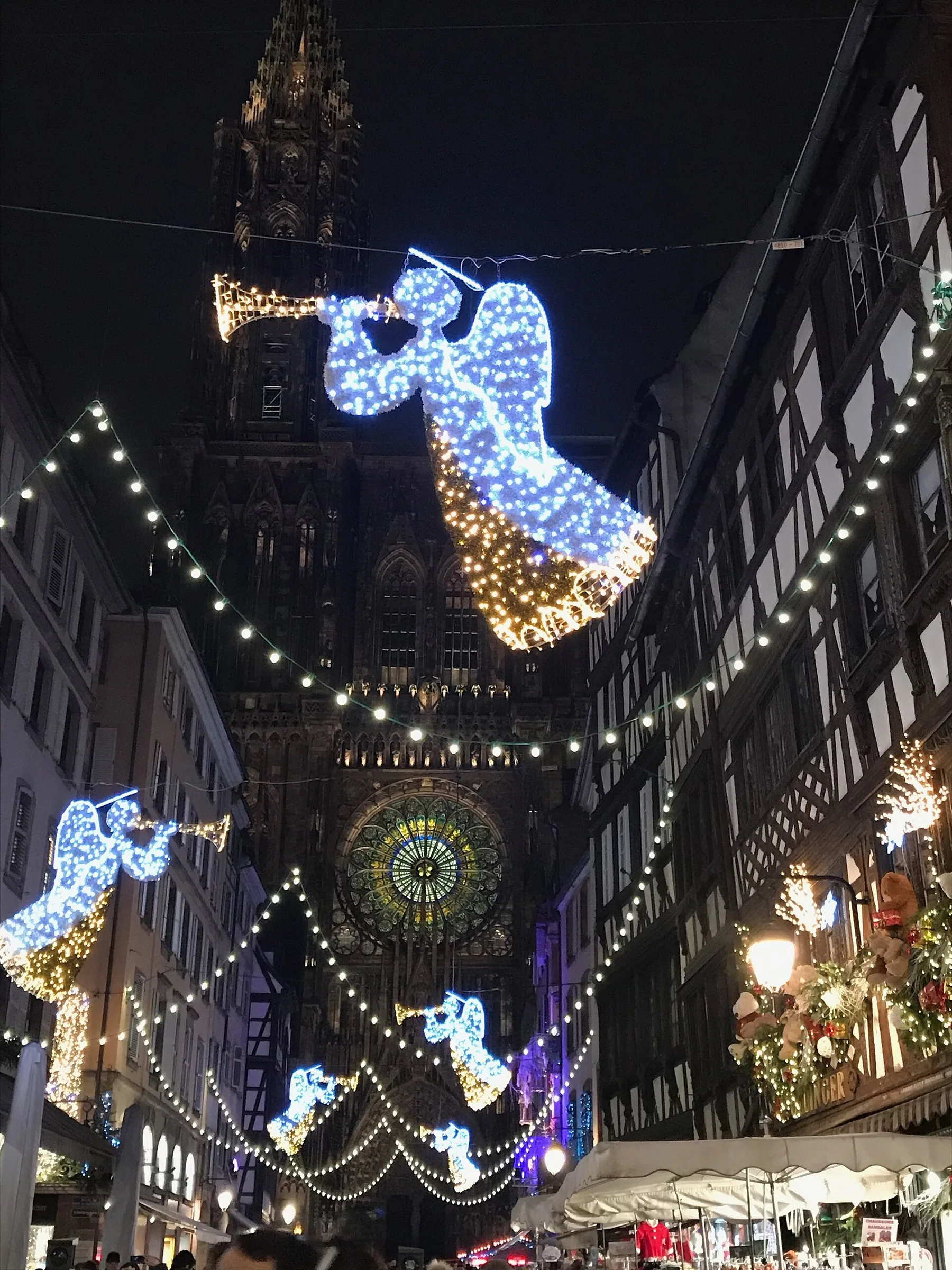
The Cathedral and Château squares are naturally visited together. The sandstone façade and the surrounding buildings give the rows of stalls a different sense of scale. You can spend your first visit browsing the goods and specialties, then return through the nearby streets as the illuminations become part of the scenery. Rue Mercière, in particular, offers a view of the cathedral façade.
The Rohan Terrace and Place du Marché-aux-Poissons extend this part of the visit toward the Ill. Quai des Délices is the food-focused area highlighted by the City: bakers from Bas-Rhin and Alsatian winemakers showcase their products there. It is a good place to take a break before continuing to the other squares, especially if you want to sample several specialties without booking a meal at a fixed time.
Plan separately for a possible visit inside the cathedral. Check the relevant website for details and for a climb to the viewing platform; chalet opening hours are not the same as the monument’s hours. If your first day is already devoted to the markets, seeing the exterior and the adjacent streets is enough for a substantial stop. You can devote more time to the heritage on a second visit.
Place Broglie and Place Kléber
At Place Broglie, the Chrìstkìndelsmärik carries the history of Strasbourg’s market. The City dates its origins to 1570 and its move to this square to 1871. These dates explain why it is considered an old market, even though it is now held at Broglie. Include this stop if you want to connect the contemporary decorations with the city’s festive history.
Place du Temple Neuf and its Carré d’Or market offer another stop between the central areas. Add it depending on how much time you have spent elsewhere. On a busy day, it is just as reasonable to head straight to your final major square, especially if you have planned a sit-down lunch or are traveling with children.
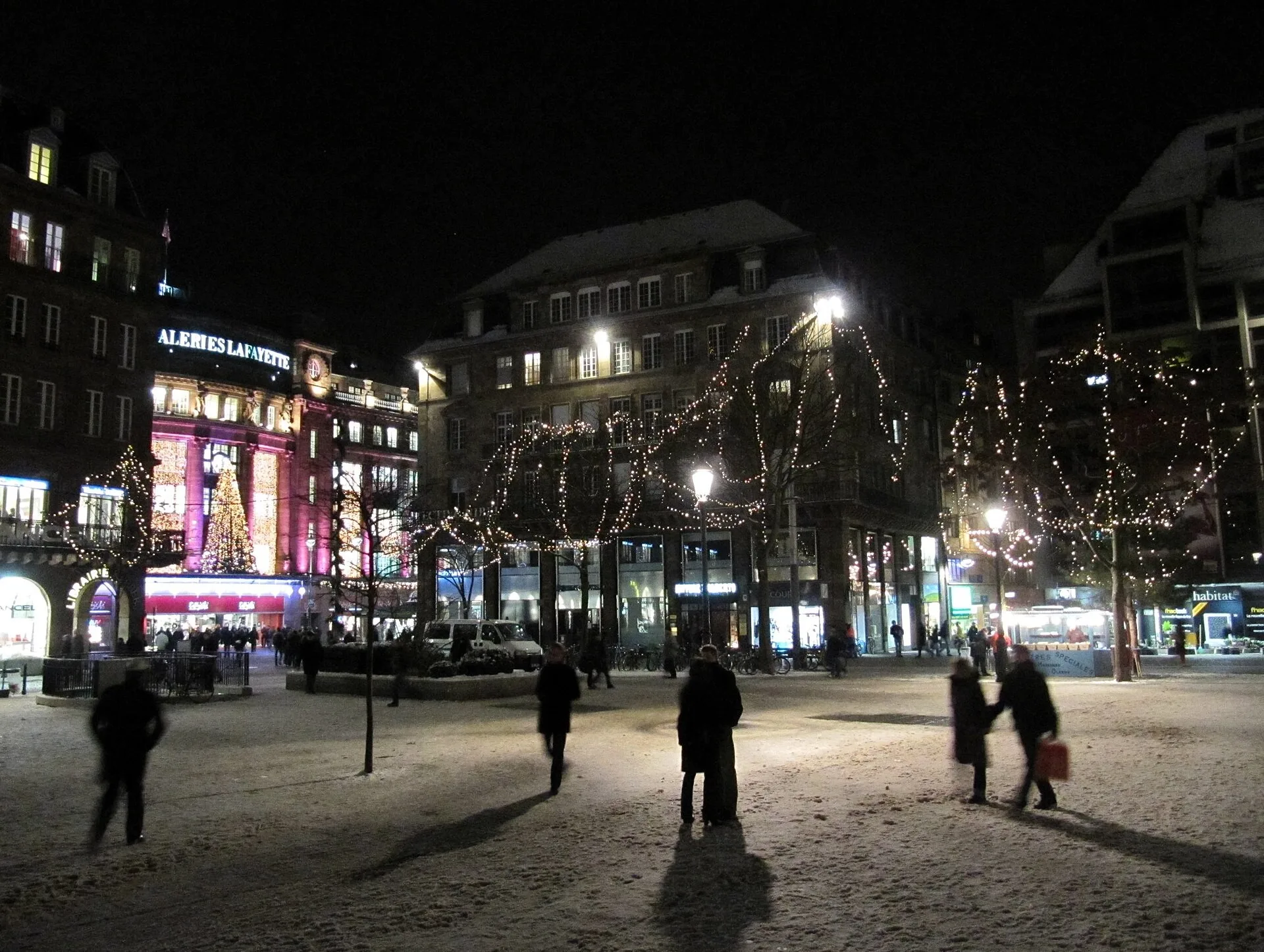
At Place Kléber, the Great Christmas Tree is the landmark to keep in mind for early evening. The Village du Partage brings together associations, with purchases and charitable initiatives. Take time to look at what they offer instead of reducing your visit to a photo of the tree. Making this area the day’s final stop gives your group a simple direction without requiring you to visit every square in a rigid order.


Meals, gifts and budget
Bredle, also called bredele, are small biscuits associated with Christmas in Alsace. Along with gingerbread, they are an easy specialty to take home. Compare the ingredients, sizes and storage requirements before buying for several people. A product you plan to give as a gift a few days later deserves more consideration than a treat you will eat during your walk.
For lunch, choose between sampling several small items and sitting down somewhere warm. The first option keeps the day flexible; the second gives you a proper break, which is useful if you have been walking since late morning. If you choose a restaurant, book with your sightseeing area in mind. A table near your midday stop saves you from having to cross the city center again as the crowds grow.
Your budget is split between transportation, possible accommodation, meals, drinks, gifts and a guided activity. Free entry means you can enjoy the markets even if you buy very little. To control your spending, set a souvenir budget in advance and decide whether lunch will be a full meal. Prices displayed at the stalls and current menus are the best references for adjusting your budget on site.
Drinks are served in a deposit-return cup: the official FAQ states that the deposit is €1. You can return it to a chalet selling drinks to get the money back, or put it in a donation bin to give the deposit to charity. Keep some cash on hand as well; the City says nearly all vendors accept cards, while advising visitors to plan ahead if they need to withdraw cash.
A one-day itinerary
Arrive with enough time to drop off your belongings and reach your first market around opening time. From the train station, start in Petite France and, if its offerings interest you, visit Place Grimmeissen as well. This first part combines the neighborhood, the stalls and gift shopping. Families can shorten it to save their energy for the evening.
Next, head to the area around the cathedral and the Rohan district for a midday break. Make time to sit down, especially if it is raining. In the afternoon, continue toward Broglie, with a stop at Temple Neuf if you like, then finish at Kléber as the light fades. This is a suggested itinerary; it does not assume an official visit duration or a specific lighting-up time.
If your train leaves early, focus on the cathedral, Broglie and Kléber. If you have two days, set aside Petite France and the OFF Market for another half-day instead. That way, you can spend longer with an artisan or add a cultural visit. For your return to the station, leave a separate buffer beyond the time set aside for last-minute shopping, and check the arrangements for retrieving your luggage.
Children and accessibility
With young children, two or three well-chosen areas are enough for a complete outing. Alternate between the stalls, a walk and a break indoors. Hands get cold quickly when you linger at a stall; layered clothing, gloves and shoes suited to wet weather make these stops more comfortable. Bring an outfit warm enough for times when your child is standing still.
Strollers are allowed, but the City warns that getting around can be difficult at peak times and recommends using a baby carrier on weekends. The FAQ says there is a space for babies and breastfeeding; check its location on the event map before setting out on a long walk. For restrooms, the official map and the Ici Toilettes app can help you find free facilities, some of which are accessible to people with reduced mobility.
Visitors with accessibility needs can plan a shorter route around Kléber and the squares they actually want to see. The FAQ states that wheelchairs and rollators can be borrowed free of charge from the Kléber information chalet, with an ID deposit and no reservation required. Contact the City to confirm the arrangements relevant to your visit and whether an adapted tour is available. A route planned with the relevant services will be more useful than a long list of markets to visit.
A guided tour of the markets
A private tour is a good option if you want to ask questions about the traditions and have a guide organize the connections between neighborhoods. The Viator experience selected here, focused on Christmas in Strasbourg, offers two- or three-hour walking tours. The advertised route includes Place Kléber, Petite France and the exterior of the cathedral. The guide speaks English.
You pay for food and drinks separately. The meeting point is arranged with the provider, who lists options around Kléber, the train station or your hotel. Choose a date and tour option that fit your arrival; the calendar for this offering, checked for winter 2026, runs through December 23. Check which time slots are actually bookable for your group when you make your purchase.
We would schedule this tour at the start of your stay so you have free time afterward in the areas you enjoyed. If you only have one day, the shorter option leaves more time for lunch and shopping. The map below links to this specific experience, with the commercial information and the partner’s booking terms in one place.

Viator
Christmas in Strasbourg: private walk with an English-speaking guide
A private English-speaking guide to connect the markets and introduce you to local traditions. Two or three hours, depending on the option; food and drinks are paid for separately.
- 2 or 3 hours, depending on the option
- 5/5 (3 reviews)
A two- or three-hour private walking tour in English, taking in Kléber, Petite France and views of the cathedral from outside. Food and drinks at your own expense. Meeting point to be agreed with the guide; choose a time slot that can actually be booked before December 24.
Cancellation policy
For a full refund, cancel at least 24 hours before the scheduled departure date.
From €50.00
View activityFAQ
Can you visit Strasbourg’s Christmas Market after December 24, 2026?
The chalets close for the season on December 24 at 6 p.m. for this edition. The City says they do not reopen on December 25 or through New Year’s Eve. If you are traveling after that date, plan your stay around heritage sites and activities whose opening hours have been confirmed, rather than around the markets.
Do you need a ticket to visit the markets?
Admission to the markets is free. You can walk between the squares and browse the stalls without booking an activity. You pay for purchases and refreshments on site; a guided-tour ticket pays for the tour, with inclusions listed in its details.
How much time should you allow for a first visit?
A full day allows you to cover the main areas and include a meal as well as a visit after dark. For a half-day, choose a few nearby squares, such as the cathedral, Broglie and Kléber. Staying overnight makes it easier to take breaks and revisit a neighborhood the next day.
Where can you park if you arrive by car?
CTS park-and-ride facilities let you leave your vehicle outside the city center and continue by public transport. The operator’s advertised all-day occasional-use ticket costs €4.20 and provides unlimited bus and tram travel for one to seven people, from 4:30 a.m. to 2 a.m. Validate your ticket on board and check which ticket is right for you if you park for longer. Traffic on the Grande Île is regulated during the markets.
When is the best time to visit with a stroller?
Choose a Monday or Tuesday, as soon as the chalets open at 11 a.m. It is harder to get around with a stroller when the aisles fill up, especially at weekends. Keep your plans brief, locate the baby-care area on the official map, and plan a warm place to take a break rather than trying to visit every market in one go.
What can you find at the OFF market?
On Place Grimmeissen, the OFF market highlights the social and solidarity economy: its offerings include second-hand goods, local crafts and responsible shopping. It gives you the chance to look for a different kind of gift than those found at traditional stalls. Check its program to choose an activity that matches the day of your visit.
Is the recommended guided tour conducted in French?
The private Christmas tour featured here advertises an English-speaking guide, with two- or three-hour options. It includes a walking tour; drinks and food are paid for separately. Book according to the language your group understands and how much time you want to leave for exploring on your own.
Can I bring my dog or bicycle?
Dogs on a leash are allowed; weekday mornings are recommended for their comfort, as it gets crowded. While the chalets are open, bicycles and scooters must be walked on the Grande Île, and riding them is prohibited in the market squares. Plan to explore the stalls on foot.
Sources and checks
Plan your visits and check current conditions.
- Christmas in Strasbourg 2026 calendar ↗
City of Strasbourg · Accessed October 30, 2026
What this source supports
November 27 to December 24, 2026 edition; the page’s old 2025 blocks are not used.
- Official FAQ: opening hours and visitor information ↗
City of Strasbourg · Accessed October 30, 2026
What this source supports
November 27, 2 p.m.–9 p.m.; then 11 a.m.–9 p.m.; December 24, 11 a.m.–6 p.m.; chalets close after December 24. €1 cup deposit, station access, security checks, luggage, strollers, restrooms, equipment loans, dogs, and bicycles. Distinction between market access and bookable services.
- The markets and their locations ↗
City of Strasbourg · Accessed October 30, 2026
What this source supports
Eight areas: Rohan/Place du Marché-aux-Poissons, Louise Weiss, Temple Neuf, cathedral/Château, Benjamin Zix/Saint-Thomas, Kléber, Broglie, and Grimmeissen.
- History of the Chrìstkìndelsmärik ↗
City of Strasbourg · Accessed October 30, 2026
What this source supports
Origin in 1570; moved to Place Broglie in 1871.
- Le Quai des Délices ↗
City of Strasbourg · Accessed October 30, 2026
What this source supports
Rohan terrace and Place du Marché-aux-Poissons; bakers from Bas-Rhin and Alsatian winemakers, bredle. No food or drink prices included.
- The OFF market ↗
City of Strasbourg · Accessed October 30, 2026
What this source supports
Place Grimmeissen, social and solidarity economy, shipping containers, second-hand goods, and creative work. The anniversary and undated new features are not carried over as part of the 2026 program.
- Getting to Strasbourg and choosing your day ↗
City of Strasbourg · Accessed October 30, 2026
What this source supports
Maps at information points; crowds are generally lighter on Mondays and Tuesdays.
- Park-and-ride terms ↗
CTS · Accessed October 30, 2026
What this source supports
Occasional day pass: €4.20, unlimited bus and tram travel for 1 to 7 people, from 4:30 a.m. to 2 a.m. Validate the ticket; other options are available for longer stays.
- Private Christmas tour: product 5601609P8 ↗
Viator — Partner API · Accessed October 30, 2026
What this source supports
Product page and Basic calendar checked in production on October 30, 2026: active product, English-speaking guide, two- and three-hour private options, exterior visit to the cathedral, food and drinks not included. 2026 calendar ends on December 23, with no availability guaranteed. Affiliate URL specific to the account, provided by the API; the booking links in this article are affiliate links.
- Photograph: cathedral and Rue Mercière, 2017 ↗
Wikimedia Commons — Romynine · Accessed October 30, 2026
What this source supports
File inspected; author Romynine, December 22, 2017, CC BY-SA 4.0. Illuminated angels and cathedral; an archive photograph, not the 2026 decorations.
- Photograph: Place Kléber, 2010 ↗
Wikimedia Commons — francois · Accessed October 30, 2026
What this source supports
Commons imageinfo consulted, file inspected: francois, December 2, 2010, CC BY 2.0. Illuminated trees and façades, not the Great Christmas Tree. Resizing and conversion noted in the registry.
Viator — activity pages
Source for the activity information below.Affiliate links: Odyvero may earn a commission when you book through this article’s buttons.
- Christmas in Strasbourg: private walk with an English-speaking guide ↗
Accessed October 31, 2026


